Table of Contents
- What Business Cleaning Companies Actually Offer
- Industries Served by Professional Janitorial Services
- Creating a Commercial Cleaning Contract Proposal Template
- Using a Commercial Cleaning Walkthrough Checklist
- How to Price Commercial Cleaning Jobs
- Sustainability and Eco-Friendly Cleaning Practices
- Choosing the Right Business Cleaning Partner
- Frequently Asked Questions
Last Updated: September 23, 2026
What Business Cleaning Companies Actually Offer
A business cleaning company provides comprehensive facility maintenance designed to keep commercial spaces hygienic, presentable, and compliant with health standards, including deep sanitization, floor care, carpet extraction, and specialized treatments for high-touch surfaces.
Most providers offer customized cleaning schedules, weekly, bi-weekly, monthly, or seasonal, tailored to your operational demands. North Shore Maids structures cleaning plans around each client’s unique requirements, ensuring the service matches actual usage patterns and traffic flow.
Common services include restroom sanitation, waste removal, window washing, and disinfection of high-touch areas. Quality business cleaning companies maintain consistency through regular inspections and staff training.
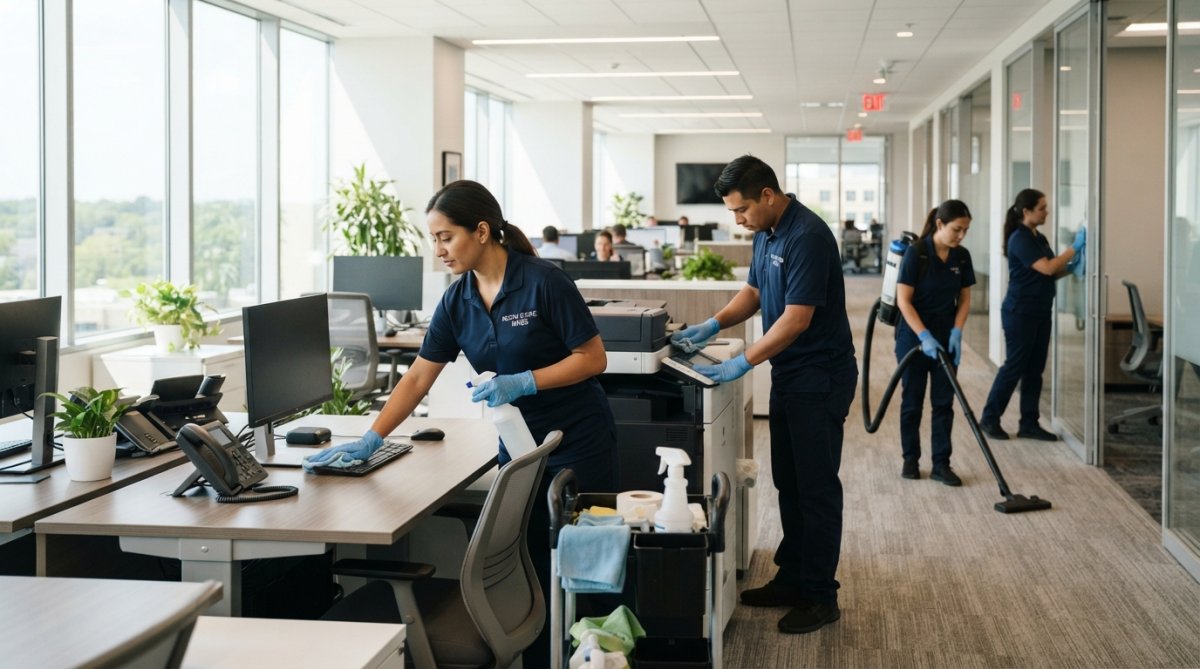
Request a service walkthrough before committing to any contract. A reputable company will assess your space in person, identify specific cleaning needs, and propose a realistic schedule and scope. This prevents surprises later.
Industries Served by Professional Janitorial Services
Business cleaning companies serve diverse sectors with distinct requirements: office buildings need regular dusting and restroom maintenance; retail spaces require floor care and window cleaning; medical facilities demand strict sanitization and compliance.
Industrial facilities require expertise in concrete floors and machinery areas. Educational institutions need high-volume cleaning for student traffic. Hospitality venues require rapid turnaround between guests and meticulous food preparation area sanitation.
Manufacturing plants and warehouses contract with business cleaning companies for preventative maintenance. Financial institutions and government offices require vetted, bonded staff. Choosing the right provider requires matching their experience to your facility type.
Not all business cleaning companies specialize in your industry. Ask potential providers about their experience in your specific sector, healthcare cleaning is different from retail, and manufacturing facilities have needs that office buildings don’t share.
Creating a Commercial Cleaning Contract Proposal Template
A solid contract proposal specifies the scope of work (areas cleaned, tasks included, exclusions), cleaning schedule (days, times, frequency), and pricing structure to prevent ambiguity.
The proposal should itemize costs, specify what happens if additional services are requested, and define term length and renewal or cancellation terms.
The proposal should require bonded and insured employees, specify quality standards and inspection frequency, define the complaint process, and include satisfaction guarantees for re-cleaning if needed.
Specify communication protocols: who to contact for no-shows or rescheduling, and required notice for changes.
| Element | Details |
|---|---|
| Scope of Work | Specific areas, tasks, frequency, depth |
| Schedule | Days, times, duration, start date |
| Pricing | Per-visit cost, monthly total, payment terms |
| Staffing | Bonded/insured requirement, crew size |
| Quality Standards | Inspection frequency, complaint process |
| Term | Contract length, renewal, cancellation terms |
| Communication | Contact person, response times, change procedures |
Using a Commercial Cleaning Walkthrough Checklist
A walkthrough checklist ensures nothing gets missed. Document your facility’s layout, square footage, floor types, specialized areas, high-traffic zones, and rarely-used spaces.
List specific cleaning requirements for each space and any compliance requirements (OSHA for healthcare, FDA for food service).
Walk the space with the potential cleaning company and observe whether they ask detailed questions and identify problem areas, revealing whether they understand facility management or follow a generic checklist.
Document your space’s condition with baseline photos of difficult-to-clean or damage-prone areas to protect against disputes.
Walkthrough Checklist:
- Facility layout and square footage
- Floor types and condition (carpet, tile, concrete, hardwood)
- Number and type of restrooms
- Kitchen or food service areas
- High-traffic zones requiring frequent attention
- Sensitive equipment or documents needing special care
- Compliance requirements (healthcare, food service, safety standards)
- Current cleanliness issues or problem areas
- Baseline photos of existing conditions
- Preferred cleaning schedule and timing
- Access and security procedures
How to Price Commercial Cleaning Jobs
Pricing depends on square footage, frequency, service depth, floor type, and local rates. Understanding the cost structure helps you evaluate quotes.
Typical Pricing Models
Most business cleaning companies use one of three pricing approaches:
- Per-square-foot pricing: $0.05-$0.15 per square foot per visit for standard office cleaning. A 10,000-square-foot office cleaned weekly costs $500-$1,500 per visit.
- Monthly retainer: $1,500-$5,000+ monthly for mid-sized offices, offering budget predictability.
- Per-visit flat fee: $200-$1,000+ for smaller offices or one-time deep cleans.
Variables That Increase Cost
Several factors add expense: carpet extraction (20-40% premium), high-touch sanitization (10-20% premium), specialized services ($500-$3,000+), after-hours service (25-50% more), and heavily soiled spaces (15-30% more).
Evaluating Quotes
When requesting estimates, ask providers to itemize costs by service category (floor care, restroom sanitation, window cleaning, etc.). This reveals what’s included in the base price and what’s extra. A quote of $800 monthly might include vacuuming, dusting, and restroom cleaning, while window washing and carpet extraction are separate line items.
Request at least three quotes from providers with relevant experience in your facility type.
Red Flags in Pricing
Negotiate contract terms when signing annual agreements. Many business cleaning companies offer 5-10% discounts for 12-month prepayment or longer commitments, reducing your effective cost while giving them revenue certainty.
Sustainability and Eco-Friendly Cleaning Practices
Environmentally responsible business cleaning companies use green products and methods that reduce chemical exposure, lower environmental impact, and often meet regulatory compliance standards. For facility managers balancing sustainability goals with safety and cleanliness, understanding green cleaning certifications and standards is critical.
Green Cleaning Standards and Certifications
- Green Seal Certification: Products bearing the Green Seal mark meet strict standards for environmental responsibility, toxicity, and performance. Green Seal-certified cleaners are safer for indoor air quality and aquatic ecosystems. Many healthcare and educational facilities require Green Seal products to meet institutional sustainability commitments.
- EPA Safer Choice Label: The Environmental Protection Agency’s Safer Choice program identifies cleaning products that contain safer chemical ingredients without sacrificing effectiveness (the EPA). Products with this label have been vetted for reduced health and environmental risk.
- OSHA Compliance: While OSHA doesn’t mandate specific cleaning products, it requires that facilities maintain safe chemical storage, labeling, and employee training. Green cleaning products often simplify OSHA compliance because they have lower toxicity and fewer hazard communication requirements.
- Cradle to Cradle Certification: Some advanced cleaning companies use products certified under Cradle to Cradle standards, meaning ingredients are designed to biodegrade safely or be recycled without environmental harm.
How Green Cleaning Methods Work
- Plant-based and biodegradable products: Cleaners derived from citrus, vinegar, or plant enzymes break down safely in water systems and reduce indoor air pollution. Studies show these perform as effectively as conventional chemicals for standard office and retail cleaning.
- Microfiber technology: Microfiber cloths and mop systems trap dirt and bacteria using mechanical action rather than chemical residue, reducing water consumption by 50-80% compared to traditional cotton mops. This also lowers chemical runoff into municipal water systems.
- Electrolyzed water systems: Some advanced cleaning companies use equipment that generates sanitizing solution from tap water and electricity, eliminating chemical residue entirely. This technology is increasingly used in healthcare facilities where chemical sensitivity is a concern.
- Concentrated products and dilution systems: Rather than shipping heavy water-based cleaners, some providers use concentrated formulas diluted on-site, reducing packaging waste and transportation emissions.
When Green Cleaning Has Limits
- Healthcare facilities: Hospitals and medical offices may need EPA-registered disinfectants with proven efficacy against specific pathogens, which not all green products provide. However, many healthcare facilities now use green products for routine cleaning and reserve traditional disinfectants for high-risk areas.
- Industrial facilities: Heavily soiled manufacturing floors or equipment with grease buildup may require stronger solvents than plant-based alternatives can provide.
- Food service areas: While green products can sanitize food prep surfaces, some facilities prefer EPA-registered disinfectants for regulatory certainty, though green alternatives increasingly meet FDA standards.
Implementing Green Cleaning Without Cost Premiums
- Microfiber systems reduce labor time and water consumption, offsetting higher product costs.
- Concentrated products lower per-use cost despite higher upfront pricing.
- Reduced chemical hazards lower worker compensation insurance and OSHA compliance costs.
If your organization has ESG (Environmental, Social, Governance) goals or sustainability commitments, verify that your cleaning provider can document their practices with third-party certifications like Green Seal or EPA Safer Choice. This protects your organization’s credibility and ensures cleaning methods align with your public commitments.
Choosing the Right Business Cleaning Partner
Selecting a business cleaning company requires balancing reliability, quality, cost, and fit with your specific needs. Start by identifying companies with relevant experience in your industry and facility type. A provider experienced in healthcare cleaning has different expertise than one focused on retail spaces.
Frequently Asked Questions
How much does it cost to clean a business?
Cost depends on square footage, cleaning frequency, service scope, and facility type. A small office cleaned weekly may cost less than a large industrial space requiring deep cleaning and sanitization. Most business cleaning companies provide free estimates after a walkthrough to assess your specific needs. Request a quote from your local provider to get accurate pricing for your facility.
What should be included in a commercial cleaning contract?
A solid commercial cleaning contract proposal template should outline the scope of work (daily maintenance, deep cleaning, floor care, restroom sanitation), cleaning schedule (weekly, bi-weekly, or monthly), pricing structure, service areas, insurance and bonding details, quality control measures, and cancellation terms. The contract should also specify which high-touch surfaces receive disinfection and how disputes are resolved. Always request a written contract before work begins.
How do I find reputable commercial cleaning companies?
Look for bonded and insured providers with verifiable experience in your industry. Check references from similar businesses, review their service walkthrough process, and confirm they use professional equipment and quality cleaning products. Ask about their quality control procedures and whether they customize cleaning plans. Request a free estimate and service walkthrough to evaluate their professionalism and attention to detail before committing.
What makes a reliable cleaning crew for my business?
Reliability means consistent arrival times, trained staff, transparent communication, and accountability for quality. Reputable business cleaning companies maintain bonded and insured employees, perform background checks, and use standardized cleaning protocols. They should provide a dedicated team or clear scheduling, offer flexibility for customized cleaning schedules, and respond promptly to concerns. Satisfaction guarantees and free estimates are signs of confidence in their service.
Selecting the right business cleaning company transforms how your facility functions. The difference between reliable, consistent cleaning and inconsistent service affects both your team’s productivity and client perceptions. North Shore Maids brings nearly two decades of experience, bonded and insured staff, and a satisfaction guarantee to every engagement. Request a free estimate and walkthrough to see how customized cleaning plans can support your facility’s specific needs.