
Table of Contents
- Professional Cleaning vs Deep Cleaning for Real Estate Photos: The Camera Lens Test
- Real Estate Photography Cleaning Checklist: What the Camera Actually Sees
- How Long Does a Deep Clean Take Before a Photo Shoot?
- Deep Cleaning Baseboards and Grout: The Details That Sell Homes
- DIY vs Professional Cleaning: A Decision Matrix for Sellers
- The ROI of a Photo-Ready Home: Market Value, Time on Market, and Online Views
- Post-Cleaning Maintenance: Keeping the Home Photo-Ready Until Closing
- Conclusion: Choosing the Right Clean for Your Listing Photos
- Frequently Asked Questions
Last Updated: September 30, 2026
Professional Cleaning vs Deep Cleaning for Real Estate Photos: The Camera Lens Test
Professional cleaning vs deep cleaning for real estate photos comes down to one distinction: standard cleaning maintains a home for daily living, while deep cleaning prepares every surface for the unforgiving eye of a high-resolution camera. A lens captures what daily cleaning routines miss, including streaks, dust on baseboards, and grime in grout lines.
Real Estate Photography Cleaning Checklist: What the Camera Actually Sees
A real estate photography cleaning checklist exists because cameras see differently than people do: the eye filters out minor imperfections, while a high-resolution lens records them. The common mistake is cleaning for comfort instead of for the frame.
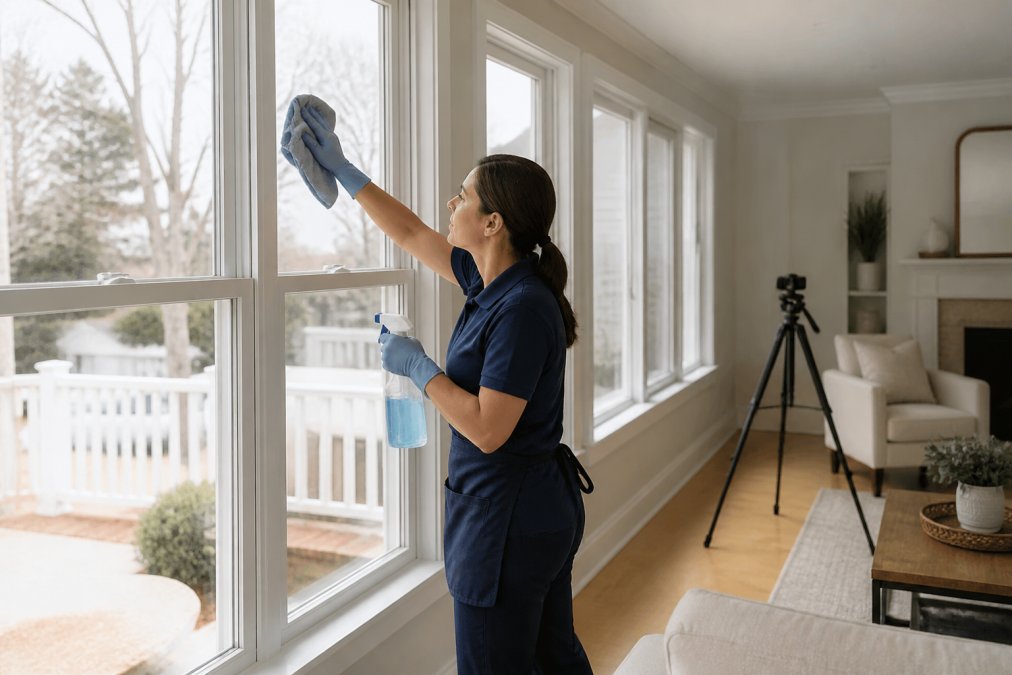
- Windows and glass doors: Streaks and smudges show up as hazy patches in listing photos
- Reflective surfaces: Stainless steel, mirrors, and glossy countertops amplify every fingerprint
- Light fixtures: Dust on bulbs and shades dims a room and creates visible specks
- Floors: Scuff marks and dull finishes read as wear, even in newer homes
- Baseboards and trim: Dust lines at the floor level are among the most photographed flaws
High-Impact Zones: Glass, Reflective Surfaces, and Light Fixtures
Glass cleaning and reflective surfaces deliver the biggest visual return per minute spent, because natural light passes through clean glass instead of scattering.
The Mess Camera Angles Expose: Clutter, Cords, and Countertops
Camera angles expose clutter that daily life hides: wide-angle lenses stretch a room, magnifying cords, papers, and small appliances on counters.
How Long Does a Deep Clean Take Before a Photo Shoot?
A deep clean before a photo shoot takes longer than a standard cleaning because it covers surfaces routine maintenance skips. Timing depends on home size and condition, but the common approach is to schedule it one to two days before the photographer arrives, leaving a buffer for touch-ups.
A practical sequence looks like this:
| Phase | Focus | When to Schedule |
|---|---|---|
| Decluttering | Counters, shelves, cords | 3-5 days before |
| Deep clean | Baseboards, grout, glass, fixtures | 1-2 days before |
| Touch-up | Floors, glass, final staging | Morning of the shoot |
Photographers often shoot rooms in a specific order, starting with the rooms that take longest to reset. Ask the photographer’s sequence ahead of time so the final touch-up happens in the rooms shot last, not first.
Deep Cleaning Baseboards and Grout: The Details That Sell Homes
Deep cleaning baseboards and grout separates a listing that looks maintained from one that looks neglected. These details sit low in the frame, but they anchor every wide shot. Buyers read dirty grout as a maintenance problem, whether or not one exists.
Skipping baseboards and grout before a shoot is one of the most common pre-listing mistakes. The consequence is subtle but real: photos that look slightly tired, which pushes buyers toward listings that photograph cleaner.
DIY vs Professional Cleaning: A Decision Matrix for Sellers
The DIY versus professional decision comes down to three variables: the condition of the home, the seller’s available hours, and the tolerance for re-doing work after the photographer reviews the shots.
The Three-Question Screen
Before comparing costs or supplies, run the home through this screen:
- Condition: When were baseboards, grout, window tracks, and vent covers last cleaned? If the answer is “never” or “not since we moved in,” the home needs a deep clean, not a standard one.
- Time: How many uninterrupted hours can the seller commit in the 72 hours before the shoot? A photo-ready deep clean on a 2,000-square-foot home commonly runs 6 to 10 hours for one person, spread across two days to let surfaces dry and dust settle.
- Tolerance for re-work: If the photographer flags a hazy window or dusty ceiling fan, is the seller prepared to reset the room and pay for a reshoot? Reshoot fees and delays usually cost more than the original cleaning would have.
DIY: When It Works
DIY is a reasonable path when all three of these are true:
- The home is under roughly 1,800 square feet and was deep cleaned within the last 12 months
- The seller has two full days available before the shoot
- No pets, no smokers, and no recent renovation dust in the home
Hire a Professional: When DIY Fails
Hiring is the right call when any of these apply:
- The home has not had a deep clean in over a year, or has never had one
- There are pets, smokers, or recent construction dust
- The seller is also packing, coordinating repairs, or already moved out
- The listing timeline is under two weeks
- The home is over 2,500 square feet, or has multiple full bathrooms and a large kitchen
The Hybrid Path Most Sellers Miss
A middle option works well for homes in decent condition: hire a professional for the high-impact zones the camera punishes most, window and glass cleaning, grout and tile work, carpet cleaning, while the seller handles decluttering, countertop clearing, cord management, and personal-item removal.
What to Ask Before Booking
When comparing providers, ask four questions:
- Is the team bonded and insured?
- Do they work from a written checklist, or from memory?
- Do they offer a satisfaction guarantee that covers a re-clean if the photographer flags an issue?
- Can they schedule the clean 1 to 2 days before the shoot, not the morning of?
The answers separate providers who clean for photography from those who clean for daily living: a team working from a checklist hits baseboards, vent covers, and window tracks without being asked, while a team working from memory hits whatever is most visible and skips the rest.
A common mistake is hiring the lowest quote and hoping for the best. Cleaning for photography is a specific skill, and results vary widely between providers. The cost difference between the lowest and mid-range quote is usually smaller than the cost of a reshoot or a price reduction caused by weak listing photos.
The ROI of a Photo-Ready Home: Market Value, Time on Market, and Online Views
A photo-ready home earns more online views, and online views drive showings. Buyer attention is finite: listings with clean, bright, high-resolution photos stop the scroll, while dim, cluttered images get passed over before a buyer reads the description.
Lever 1: Online Views and Click-Through
Listing platforms show buyers a grid of thumbnails before any text, so the thumbnail is the entire first impression: a clean, bright photo wins the click, a dim or cluttered one loses it. Most listing agents report that the first 24 to 48 hours drive a disproportionate share of total views, meaning day-one photos set the ceiling for the entire listing period.
Lever 2: Time on Market
Time on market is the lever most sellers underestimate. Every additional week listed carries costs, mortgage interest, property taxes, insurance, utilities, and HOA dues where applicable, commonly running into the hundreds of dollars per week for a home with a typical mortgage, before counting the seller’s own time and stress.
Lever 3: Selling Price and Negotiation Position
Presentation shapes perception, and perception shapes offers. A home that photographs clean signals the seller has maintained the property; one that photographs tired signals the opposite, and buyers respond by adjusting offers downward or building repair requests into the negotiation.
| Investment | Typical Relative Cost | Visible in Every Photo? |
|---|---|---|
| Pre-listing deep clean | Lowest | Yes |
| Interior paint touch-up | Moderate | Yes, in some rooms |
| Staging consultation | Moderate to high | Yes, in staged rooms |
| Landscaping and curb appeal | Moderate | Yes, in exterior shots |
| Professional photography | Moderate | N/A (it is the camera) |
The Cost of Skipping It
The downside case is easier to reason about than the upside. If a listing’s photos look tired, three things tend to happen: fewer clicks on day one, fewer showings in the first two weeks, and a longer time on market. Those outcomes compound, fewer showings means less buyer competition, which weakens the seller’s negotiation position and often shows up as a price reduction or repair credit later.
The camera does not distinguish between a home that is genuinely well-maintained and one that merely looks that way. A deep clean closes that gap for a fraction of the cost of a price reduction, and it is the only presentation investment that shows up in every interior photo.
Post-Cleaning Maintenance: Keeping the Home Photo-Ready Until Closing
Post-cleaning maintenance protects the investment between the shoot and closing. Showings, open houses, and inspections all reintroduce dust, footprints, and clutter, so a simple routine keeps the home camera-ready for every walkthrough.
A practical routine for occupied homes:
- Daily: Wipe kitchen counters, shake out entry mats, fluff pillows
- Every few days: Vacuum high-traffic floors, clean glass doors and mirrors
- Before each showing: Quick pass on bathrooms, kitchen, and entryway
- Weekly: Dust baseboards and light fixtures, check for burned-out bulbs
Conclusion: Choosing the Right Clean for Your Listing Photos
The right choice depends on the gap between how a home looks in person and how it looks through a lens. Standard cleaning maintains a lived-in home; deep cleaning prepares it for the camera. For most listings, the deep clean is the one that pays for itself.
Frequently Asked Questions
What is the difference between regular cleaning and deep cleaning a house?
Regular cleaning handles surface-level upkeep: vacuuming, dusting, wiping counters, and cleaning bathrooms. Deep cleaning goes further by targeting buildup in overlooked areas like baseboards, grout, inside appliances, vents, and behind furniture. For real estate photos, deep cleaning matters more because high-resolution cameras capture grime that daily cleaning misses. A standard tidy-up keeps a home livable; a deep clean makes it photo-ready.
What should be included in a real estate photography cleaning checklist?
A solid real estate photography cleaning checklist covers glass cleaning, cobweb removal, light bulb replacement, baseboard and grout scrubbing, decluttering surfaces, hiding cords, and sanitizing kitchens and bathrooms. Also wipe reflective surfaces like stainless steel and mirrors, since camera flashes expose streaks. Don’t forget exterior curb appeal: clean windows, swept walkways, and tidy entryways set the first impression before buyers ever step inside.
Is professional cleaning necessary before real estate photography?
It depends on your home’s condition and timeline. Professional cleaning helps when grout, baseboards, or glass need detailed attention that takes hours to handle yourself. Many sellers find that hiring a bonded and insured team saves time and delivers more consistent results. If your home is already well-maintained, a thorough DIY deep clean can work. The key is ensuring every surface looks spotless on camera, not just tidy in person.
How does a clean home impact real estate listing performance?
Clean homes photograph better, and better photos drive more online views. Listings with high-quality, high-resolution images tend to attract more buyer interest, which can support a stronger selling price and shorter time on market. Buyer perception starts with first impressions, and cluttered or grimy photos push viewers to scroll past. A photo-ready home positions your property as well-maintained, which supports its market value.
What are the most common cleaning mistakes before a home photoshoot?
Sellers often overlook reflective surfaces, forget to replace burnt-out light bulbs, and leave personal items on counters. Another frequent mistake is cleaning only visible areas while ignoring baseboards, vents, and grout lines that appear in close-up shots. Skipping cobweb removal in corners and neglecting exterior curb appeal also hurt listing photos. Address these details before the photographer arrives to avoid wasted shoot time.