
Table of Contents
- Quick Comparison: Professional Cleaning vs DIY Cleaning for Seniors
- The Benefits of Professional Cleaning for Seniors
- The Cost of Professional Cleaning Services for Seniors
- DIY Cleaning for Seniors: Safety Risks and Physical Limitations
- Specialized Equipment and Professional Expertise
- How to Choose the Right Cleaning Approach for Your Situation
- Conclusion: Making the Decision That Supports Aging in Place
- Frequently Asked Questions
Last Updated: September 12, 2026
Quick Comparison: Professional Cleaning vs DIY Cleaning for Seniors
Professional cleaning vs DIY cleaning for seniors comes down to a trade-off between cost and capability. Professional services remove physical risk and deliver consistent results; DIY saves money but demands mobility, time, and equipment that many older adults no longer have. For households managing mobility issues or chronic conditions, the safety case for hiring help usually outweighs the savings.
North Shore Maids has provided home cleaning across Essex County for nearly two decades. The pattern is consistent: families try to keep up with household chores themselves, then discover that the physical exertion involved is the real problem, not the cost.
Below is a side-by-side breakdown of what each approach actually delivers.
| Factor | Professional Cleaning | DIY Cleaning |
|---|---|---|
| Upfront cost | Higher per visit | Lower, but adds up |
| Physical demand | None on the resident | Moderate to high |
| Equipment | Professional-grade, supplied | Purchased or rented |
| Consistency | Scheduled and repeatable | Depends on energy and time |
| Safety risk | Managed by trained staff | Fall and strain risk |
| Best for | Limited mobility, health conditions | Active seniors, light upkeep |
The CDC’s older adult fall prevention guidance is blunt about why this matters: falls are the leading cause of injury for adults 65 and older, and most happen at home during ordinary activity. Cleaning involves climbing, reaching, bending, and carrying. That is a risk profile worth taking seriously before deciding who scrubs the tub.
The Benefits of Professional Cleaning for Seniors
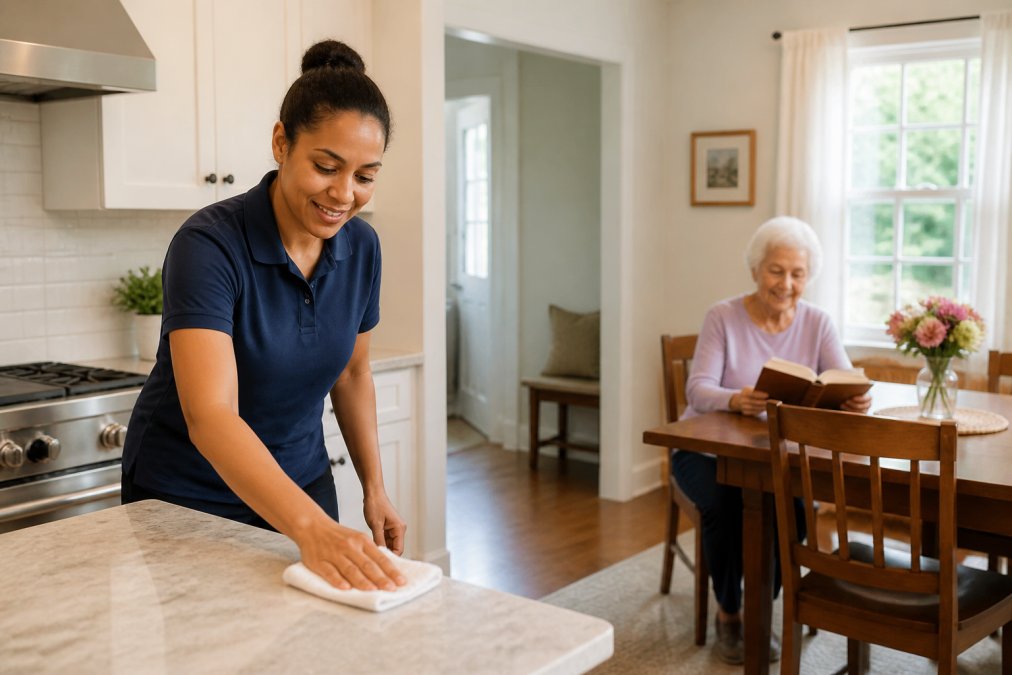
The clearest benefit is that the resident stops doing the work. A trained crew handles the labor-intensive tasks, from scrubbing bathrooms to moving furniture for vacuuming, in a single visit.
Health and Hygiene Benefits
Professional cleaning improves indoor air quality in ways routine tidying rarely does. HEPA-filtered vacuums and professional-grade products pull dust, dander, and allergens out of carpets, upholstery, and vents rather than pushing them around. For seniors managing asthma, allergies, or respiratory health conditions, that difference shows up in how the house feels day to day.
Sanitization matters too. High-touch surfaces, bathroom fixtures, and kitchen counters get disinfected properly, which reduces the spread of illness in a household where someone may have a weakened immune system.
Emotional and Mental Health Impact
A clean home changes how it feels to live in it. Clutter and grime build a low-grade stress that many seniors carry quietly, especially when they can see what needs doing but cannot safely do it. Handing that work to someone else removes the guilt and the worry in one step.
There is a practical edge here as well. A maintained home supports aging in place, keeps the space presentable for visitors and family, and preserves a sense of control over daily life. That emotional return is real, and it is the part most cost comparisons leave out.
The Cost of Professional Cleaning Services for Seniors
Professional cleaning services for seniors are priced by the job, not by a flat national rate. Most companies quote after seeing the home, and the final number reflects square footage, condition, and how often the team returns.
What Factors Affect the Price?
Several variables move the quote up or down:
- Home size and layout: More square footage, more stairs, and more bathrooms mean more labor hours.
- Frequency: Weekly and bi-weekly plans cost less per visit than one-time deep cleans.
- Condition at first visit: A home that has gone months without deep cleaning takes longer to bring up to standard.
- Add-on tasks: Inside the fridge, inside cabinets, baseboards, and under-furniture work are typically quoted separately.
- Products and equipment: Green cleaning products and specialty treatments can carry a small premium.
Because pricing depends on the home, the honest answer for any specific household is a free estimate. North Shore Maids provides free estimates and flexible weekly, bi-weekly, monthly, or seasonal plans, so the quote reflects the actual scope rather than a generic rate card.
Budgeting for Recurring Services
Treat recurring cleaning as a fixed monthly line item, the same way you would budget for utilities or lawn care. Three habits keep it manageable:
- Choose the lowest frequency that still keeps the home at an acceptable standard, then increase only if needed.
- Bundle deep-clean tasks into seasonal visits instead of paying for them monthly.
- Ask about package plans, which usually cost less per visit than booking one-offs.
For families splitting costs between siblings, a written monthly figure makes the arrangement far less awkward than reimbursing individual invoices.
Ask for a walkthrough quote rather than a phone estimate. Companies that price sight-unseen tend to pad the number, while a walkthrough usually produces a tighter scope and a lower per-visit rate.
DIY Cleaning for Seniors: Safety Risks and Physical Limitations
DIY cleaning is the right call for active seniors with light upkeep needs and no mobility issues. It stops being the right call the moment a task requires a ladder, a heavy bucket, or an hour on hands and knees.
The physical exertion is the hidden cost. Mopping, vacuuming stairs, and scrubbing showers all demand balance, grip strength, and stamina that decline with age. Ergonomic strain accumulates quietly and then shows up as a back injury or a fall. What makes cleaning uniquely risky is that it combines three fall drivers at once: reaching above shoulder height, bending below knee level, and moving across wet or cluttered floors, often in the same session.
Fall Prevention and Home Safety Audits
Fall prevention starts with a home safety assessment, and cleaning is one of the best times to do one. Walking through each room with a checklist surfaces the trip hazards that get overlooked:
- Loose rugs and runners without non-slip backing
- Cords crossing walkways
- Clutter on stairs and landings
- Poor lighting in hallways and bathrooms
- Items stored above shoulder height
- Wet floors left to air-dry
- Unstable furniture used for support when standing up
- Pet bowls, shoes, and magazines left in walking paths
A professional crew may flag these issues as they work. That kind of informal audit can be a genuine bonus of hiring help. The CDC’s older adult fall prevention guidance notes that most falls happen during ordinary activities at home, which is exactly what cleaning is.
A few mechanisms explain why cleaning falls are so common. Balance relies on the inner ear, vision, and proprioception working together, and all three decline with age. Add a wet floor, a step stool, or a heavy vacuum cord, and the margin for error shrinks fast. Grip strength matters too: a senior who cannot firmly hold a mop handle or a bucket is more likely to drop it, slip on the spill, or overcorrect and lose footing.
Never let a senior stand on a chair, step stool, or counter to reach high shelves or ceiling fans. Falls from height cause the most severe injuries, and no dusty corner is worth that risk.
Cognitive Accessibility of Cleaning Products
Product labels are a real barrier. Small print, chemical names, and warning symbols are hard to read for anyone with vision loss or mild cognitive impairment, and mixing the wrong cleaners can produce toxic fumes.
Two rules reduce the danger. First, buy products with large, clear labels and simple instructions. Second, never mix bleach with ammonia-based cleaners or vinegar (poison.org). If a household member has dementia, store all cleaning chemicals in a locked cabinet and let a caregiver or professional handle application.
Beyond mixing, storage and recognition are the quieter risks. A senior with early dementia may not recognize a spray bottle as a chemical, may mistake a cleaner for a beverage if it is decanted into an unlabeled container, or may forget that a product was already applied and reapply it in a poorly ventilated bathroom. The fix is practical: keep products in original containers, never transfer them to food or drink bottles, use single-purpose cleaners instead of concentrates that require dilution, and keep the poison control number posted where it is visible. A caregiver or professional who handles application removes the recognition problem entirely.
For seniors with any cognitive decline, the safest arrangement is to separate the decision to clean from the act of cleaning. A caregiver or professional decides what to use and when; the resident does not have to identify, measure, or mix anything.
Specialized Equipment and Professional Expertise
Professional crews bring equipment most households do not own: commercial extractors, HEPA vacuums, telescoping dusters, and floor machines. Renting comparable gear, such as a carpet extractor from a local retailer, typically runs somewhere in the range of tens of dollars per session, and the user still has to transport, operate, and return it.
That rental math looks appealing until you factor in the labor. A heavy extractor has to be loaded into a car, carried inside, filled, emptied, and maneuvered across rooms. For someone with mobility issues, that sequence is the entire problem. The rental price also excludes the consumables, cleaning solution, replacement pads, and the fuel or electricity to run the machine, and the time cost of a second trip to return it.
There is a second layer of cost that rarely shows up in a rental comparison: the risk of doing the job wrong. A consumer-grade extractor used on the wrong carpet fiber can leave the carpet wet for days, which invites mold. A floor machine run over a loose tile or a wood floor with a worn finish can cause damage that costs far more to repair than the rental saved.
Professional expertise covers the other gap: knowing which surface takes which product. Stone, hardwood, grout, and laminate all react differently to the wrong cleaner, and mistakes cause permanent damage. A few common examples illustrate the stakes. Acidic cleaners etch marble and travertine. Abrasive powders scratch glass and polished stone. Ammonia-based products dull some hardwood finishes and can discolor grout. Oil-based polishes leave a residue that traps dirt and makes future cleaning harder. Trained staff match the product to the surface rather than defaulting to whatever is under the sink.
Trained staff also arrive bonded and insured, which matters when someone is working in the home, sometimes while the resident is away. Bonding protects against theft by an employee; liability insurance covers damage to the home or injury to the worker on the property. For a family arranging access for a parent who may not be present, those two coverages are the difference between a manageable incident and a dispute. It is reasonable to ask a company for proof of both before the first visit.
Ask two questions before booking: who is actually doing the work, employees or subcontractors, and what happens if something is damaged. The answers tell you more about a company than the per-visit rate does.
For families weighing the equipment question, the honest framing is this: the rental price is the smallest part of the equation. The labor to run the machine, the risk of surface damage, and the coverage gap if something goes wrong are the parts that determine whether DIY actually saves money.
How to Choose the Right Cleaning Approach for Your Situation
The right choice depends on capability and need, not on principle. Use this framework:
- Choose DIY if the senior is active, the home is small, tasks are light, and no ladder work is required.
- Choose professional cleaning if there are mobility issues, a recent fall, a respiratory condition, or tasks like inside-cabinet and under-furniture cleaning that require real physical effort.
- Choose a hybrid if the resident can handle daily tidying but needs help with deep cleaning and seasonal maintenance.
- Reassess after any health change. A hospital stay or new diagnosis usually shifts the answer.
For families in Essex County weighing the decision, North Shore Maids offers free estimates and satisfaction-guaranteed service, with green cleaning products available on request. That makes it easy to test a single deep clean before committing to a recurring plan.
Conclusion: Making the Decision That Supports Aging in Place
The hardest part of this decision is admitting that a parent or spouse can no longer safely keep up with the house. That conversation is uncomfortable, and it is usually the reason families delay a choice that would have prevented an injury months earlier.
North Shore Maids exists for exactly that moment. With nearly two decades of local experience, a bonded and insured team, and flexible weekly, bi-weekly, monthly, or seasonal plans, the company takes the physical load off the resident and hands the family back its peace of mind. Request a free estimate from North Shore Maids and get a cleaning plan built around the home, the budget, and the person living in it.
Frequently Asked Questions
Does Medicare pay for elderly housecleaning help?
Original Medicare (Part A and Part B) generally does not cover routine housecleaning or domestic assistance. Coverage may apply only when a doctor orders skilled home health care and cleaning is part of a formal care plan. Medicare Advantage plans sometimes include limited in-home support benefits. Check your specific plan documents or call your plan provider to confirm what is covered before hiring professional cleaning for seniors.
What are the safety risks of DIY cleaning for seniors with limited mobility?
DIY cleaning involves physical exertion that can strain muscles, aggravate joint conditions, and increase fall risk. Trip hazards from wet floors, cords, and scattered supplies are a real concern. Reaching to clean high shelves or bending to scrub floors can cause ergonomic strain or loss of balance. Chemical safety is another issue: mixing certain products creates toxic fumes, and respiratory health can suffer in poorly ventilated spaces. A home safety assessment can identify which tasks are safe to do alone.
How do professional cleaning services improve quality of life for the elderly?
Professional cleaners handle labor-intensive tasks like deep cleaning, sanitization, and moving furniture, which reduces physical strain and fall risk. The benefits of professional cleaning for seniors extend beyond hygiene: a consistently clean home supports allergen reduction, better indoor air quality, and respiratory health. Many seniors report that a tidy living space lifts their mood and reduces anxiety about home maintenance. Caregiver support and task delegation also free up time for family and social connection.
What tasks should seniors outsource to professional cleaners?
Tasks that involve climbing, heavy lifting, or prolonged bending are best delegated. This includes cleaning behind appliances, washing windows, scrubbing bathrooms, vacuuming stairs, and moving furniture to clean underneath. Deep cleaning tasks like carpet extraction, inside-cabinet cleaning, and sanitization of high-touch surfaces also benefit from professional-grade products and specialized equipment. If a task requires a step stool or causes shortness of breath, it belongs on the outsourced list.
How often should seniors schedule professional home cleaning?
Frequency depends on health, mobility, household size, and budget. Many seniors choose bi-weekly service to maintain hygiene standards without overspending. Those with allergies, respiratory conditions, or pets may benefit from weekly visits for allergen reduction. Monthly or seasonal deep cleaning works for independent seniors who handle light tidying themselves. A recurring services plan with a bonded and insured provider offers consistent results and predictable scheduling.