
Table of Contents
- Why Office Disinfection Matters for Essex County Businesses
- 1. High-Touch Surface Disinfection: The First Line of Defense
- How to Choose a Disinfection Provider in Essex County
- Frequently Asked Questions
Last Updated: October 14, 2026
Why Office Disinfection Matters for Essex County Businesses
Office disinfection is the process of reducing germs on the surfaces employees and visitors touch every day, and it has become a baseline expectation for workplaces rather than an optional add-on.
The core problem is that “disinfected” means almost nothing on a cleaning invoice. A crew can wipe a conference table in four seconds and technically touch every surface. What separates a real program from a cosmetic one comes down to three things: the right product, the right dwell time, and a written scope that names the surfaces being treated.
The single most useful question to ask any provider is not “do you disinfect?” but “which products, and how long do they stay wet on the surface?” That answer reveals more than any brochure.
1. High-Touch Surface Disinfection: The First Line of Defense
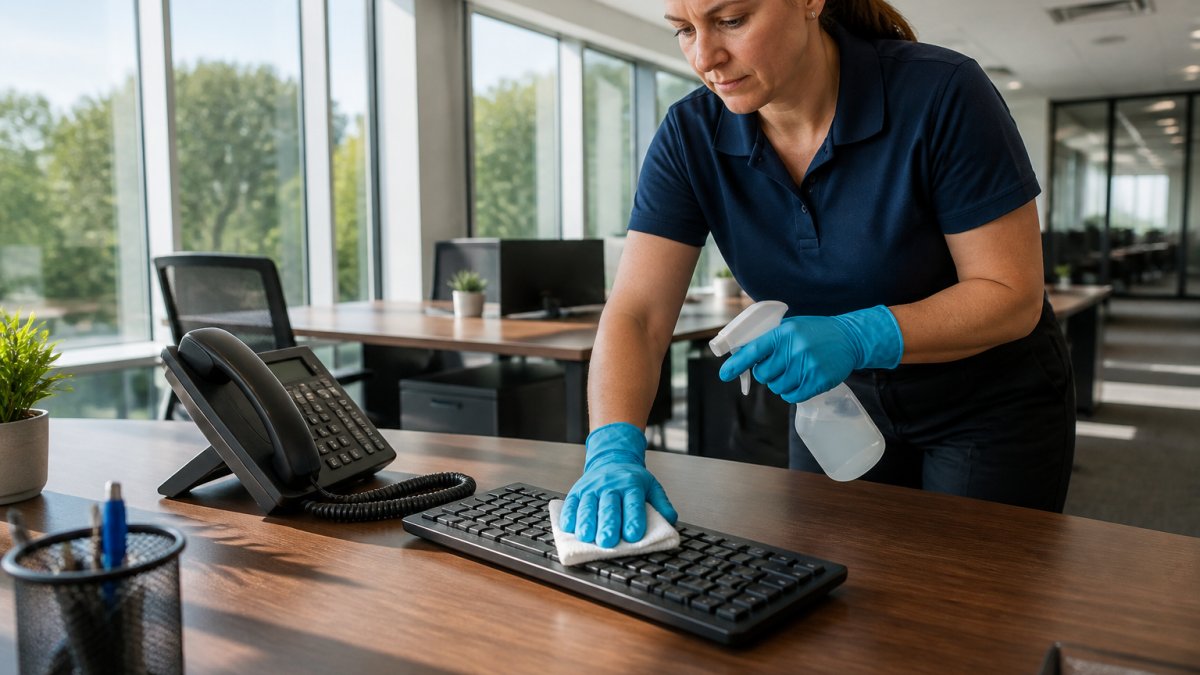
High-touch surface disinfection targets the small number of shared contact points that a disproportionate number of hands pass through each day. These surfaces deserve the most attention in any office disinfection program.
Written scope naming which surfaces are cleaned versus disinfected
- Product names, with EPA registration numbers, listed in the agreement
- Stated dwell time for each product and how the crew manages it
- Method specified per area: hand wiping, electrostatic spraying, or both
- Frequency defined for each task, not just for “cleaning”
- Restroom and break room protocols described separately
If a provider cannot produce most of this list, the gap is not paperwork. It is the program itself.
How to Choose a Disinfection Provider in Essex County
Choosing a provider comes down to evidence: documented products, defined scope, verifiable staffing, and a schedule matching how the building is actually used.
Start with credentials. A bonded and insured company protects the business if something is damaged or a worker is injured on site.
Then look at local knowledge.
Finally, get the estimate in writing and compare scopes line by line, not totals, two quotes that differ widely usually differ in what is included.
For guidance on which disinfectants are registered for specific uses, the EPA’s list of registered antimicrobial products is the authoritative reference, and the CDC’s guidance on cleaning and disinfecting facilities explains how cleaning and disinfecting differ and why the order matters. The OSHA standards for workplace safety and hazard communication set the requirements for how cleaning chemicals must be labeled and handled on site.
Frequently Asked Questions
What areas of an office should be disinfected most often?
Focus on high-touch surfaces and shared contact points: doorknobs, light switches, elevator buttons, shared keyboards, mice, desk phones, conference room tables, kitchen counters, and restroom fixtures. These areas collect the most hand contact throughout the day. A professional office disinfection service should treat them daily or at minimum several times per week, while lower-contact surfaces like window ledges and storage shelves can be handled on a weekly or monthly schedule.
How often should an office be professionally disinfected?
Office disinfection frequency depends on occupancy, foot traffic, and whether anyone on site is sick. High-traffic offices with shared workstations often need daily high-touch surface disinfection and weekly deep cleaning. Smaller offices with fewer visitors may do well with two or three visits per week. During flu season or after a confirmed illness, a one-time electrostatic disinfection or deep clean is worth scheduling between regular visits.
What is the difference between cleaning, sanitizing, and disinfecting?
Cleaning removes dirt, dust, and grime from surfaces. Sanitizing reduces bacteria to a level considered safe by public health standards. Disinfecting kills or inactivates most pathogens on a surface, but only when the product stays wet for the full dwell time listed on its label. In practice, cleaning comes first because disinfectants work poorly on dirty surfaces. A good office disinfection checklist covers all three steps in the right order.
What should businesses look for in an office disinfection service?
Ask about the disinfectants used and whether they are EPA-registered, the dwell time required, and how the provider handles high-touch surface disinfection versus general cleaning. Confirm the company is bonded and insured, request a written scope of work, and ask how they verify results. Providers with deep local knowledge of Essex County can also advise on scheduling around your hours so employees are not disrupted.
How long should employees wait before returning after disinfection?
Wait times depend on the method and product. Standard wipe-down disinfection usually requires only a few minutes of drying time. Electrostatic spraying and fogging may require the room to stay empty for 30 minutes to a few hours so the mist settles and surfaces dry. Ask your provider for the specific re-entry time tied to the product they use, and schedule treatment after hours whenever possible.