
Table of Contents
- How Professional Cleaning and DIY Compare for Your Health
- The Hidden Health Costs of DIY Cleaning
- What Professional-Grade Standards Actually Deliver
- The Cost-Effectiveness of Professional Cleaning: A Real Breakdown
- Mental Health Benefits of a Clean Home
- Benefits of Recurring House Cleaning for Busy Households
- Indoor Air Quality, Allergens, and Why DIY Falls Short
- Eco-Friendly Cleaning Standards and Long-Term Home Preservation
- Frequently Asked Questions
Last Updated: September 29, 2026
How Professional Cleaning and DIY Compare for Your Health
The decision between a professional cleaning service vs DIY cleaning for wellness comes down to more than time. It comes down to what actually gets removed from your home. This guide from North Shore Maids breaks down the real health, cost, and mental-load differences so you can choose with clear eyes.
Professional cleaning is a scheduled service performed by trained, insured staff using commercial-grade equipment and EPA-registered products. DIY cleaning means handling those same tasks yourself with consumer tools and whatever time you can spare.
The gap matters most in three places: indoor air quality, consistency, and the physical toll of doing it alone. Below, the comparison covers cost, mental health, recurring service value, and eco-friendly standards. The sections that follow explain where DIY genuinely works and where it quietly fails.
The Hidden Health Costs of DIY Cleaning
DIY cleaning looks cheaper on paper. The hidden costs show up in your body and your air.
Most households clean reactively, which means dust, dander, and microbial growth accumulate between efforts. Consumer vacuums often lack HEPA filtration, so fine particles get pushed back into the room rather than captured. A common mistake is assuming a visible clean equals a hygienic environment.
- Chemical exposure: Mixing store-bought products or over-applying them can irritate skin and airways.
- Physical strain: Scrubbing, lifting, and reaching cause back and shoulder injuries, especially without proper technique.
- Inconsistent coverage: High-touch surfaces like handles, switches, and remotes get skipped.
Skipping high-touch surfaces is the most common DIY gap. Those are the exact points where germ transmission happens, and a quick wipe with a damp cloth does not count as sanitization.
What Professional-Grade Standards Actually Deliver
Professional-grade standards deliver consistent, documented results that consumer tools cannot match. Trained teams follow set disinfection protocols, use commercial equipment, and apply products at the correct dwell times.
North Shore Maids brings nearly two decades of experience to this work, with bonded and insured staff and green cleaning products available on request. That combination covers the three things DIY rarely provides: consistency, accountability, and the right equipment for the job.
| Factor | DIY Cleaning | Professional Cleaning |
|---|---|---|
| Equipment | Consumer-grade | Commercial-grade, HEPA |
| Consistency | Varies by week | Set schedule, same standard |
| Disinfection protocols | Improvised | Documented, trained |
| Physical toll | On you | On the crew |
| Insurance and liability | None | Bonded and insured |
| Time cost | 4-8 hours weekly | Zero |
The Cost-Effectiveness of Professional Cleaning: A Real Breakdown
The cost-effectiveness of professional cleaning depends on what you count. Most DIY calculations only tally supplies, sprays, sponges, vacuum bags, mop heads, which misses the largest line item: your time. A true comparison puts a dollar figure on the hours you spend, then weighs that against a quoted service rate.
Here is the framework that makes the math honest:
- Count your actual hours. A typical whole-home clean runs 3-5 hours for a moderately sized house, and deep cleans run longer. Multiply that by how often you clean per month.
- Value those hours at your real rate. If your time is worth $30 an hour and you spend 12 hours a month cleaning, that is $360 in labor you are not counting. The IRS mileage rate for 2024 is 67 cents per mile, which is the same logic, the government puts a number on time and wear rather than treating them as free (Standard mileage rates).
- Add supply and equipment replacement. Consumer vacuums, mops, and chemicals wear out and get rebought. That is a recurring cost most DIY budgets ignore.
- Subtract the cost of a service quote. A recurring plan spreads the total across the month, so the per-visit figure is smaller than the sticker shock of a one-time deep clean.
For many dual-income households, the math flips once labor is priced in. The break-even point is not about being wealthy, it is about whether your marginal hour is worth more than the hourly cost of the service. For households where it is, outsourcing routine cleaning is a rational trade, not a luxury.
North Shore Maids offers free estimates and flexible weekly, bi-weekly, monthly, or seasonal plans, so pricing scales to the home and the frequency. Exact rates depend on square footage, condition, and add-ons, so a quote is the only accurate number for your specific home.
Ask for a walkthrough quote rather than a phone estimate. Room count, pet hair, and add-ons like inside-fridge or baseboards change the scope, and a written quote prevents surprises.
The Wellness ROI Competitors Skip
Cost analysis usually stops at time and money. The wellness layer is where the return actually compounds. A consistently maintained home reduces the reactive scramble of last-minute deep cleaning, which is the pattern that drives both physical strain and mental load. When you price the avoided back strain, the avoided weekend lost to catch-up cleaning, and the avoided decision fatigue of negotiating chores, the effective cost of a recurring plan drops further. That is the number most cost breakdowns never put on the page.
Mental Health Benefits of a Clean Home
The mental health benefits of a clean home are real and measurable in daily life. A maintained space reduces the mental load of an endless to-do list and lowers the background stress that builds when chores pile up.
Clutter and unfinished cleaning compete for attention. That constant low-grade pull erodes focus and work-life balance. When a service handles the routine, the household stops negotiating who does what and when.
- Lower daily stress and decision fatigue
- More protected personal time
- A predictable standard everyone can rely on
- Fewer conflicts over shared chores
The psychological impact goes beyond tidiness. A consistently maintained home signals order, which supports calm and recovery after demanding workdays.
Benefits of Recurring House Cleaning for Busy Households
The benefits of recurring house cleaning show up as time-efficiency and predictability. A set schedule means the home never drifts into a state that requires a full weekend to fix.
Busy households get the most from a recurring plan because maintenance beats catch-up every time. Weekly and bi-weekly visits keep high-touch surfaces, floors, and bathrooms at a consistent standard. Monthly and seasonal plans suit lighter-use homes or those handling the basics in between.
For households with mobility limitations or health issues, recurring service removes the heavy lifting entirely.
Indoor Air Quality, Allergens, and Why DIY Falls Short
Indoor air quality and allergen reduction depend on what your cleaning method actually captures. The mechanism is particle size. HEPA filtration is defined by its ability to trap 99.97% of particles at 0.3 microns, the size range where dust mite debris, pet dander, pollen, and many smoke particles sit. Standard vacuum bags and filters pass a large share of that fraction straight back into the room, which is why a freshly vacuumed carpet can still leave you sneezing.
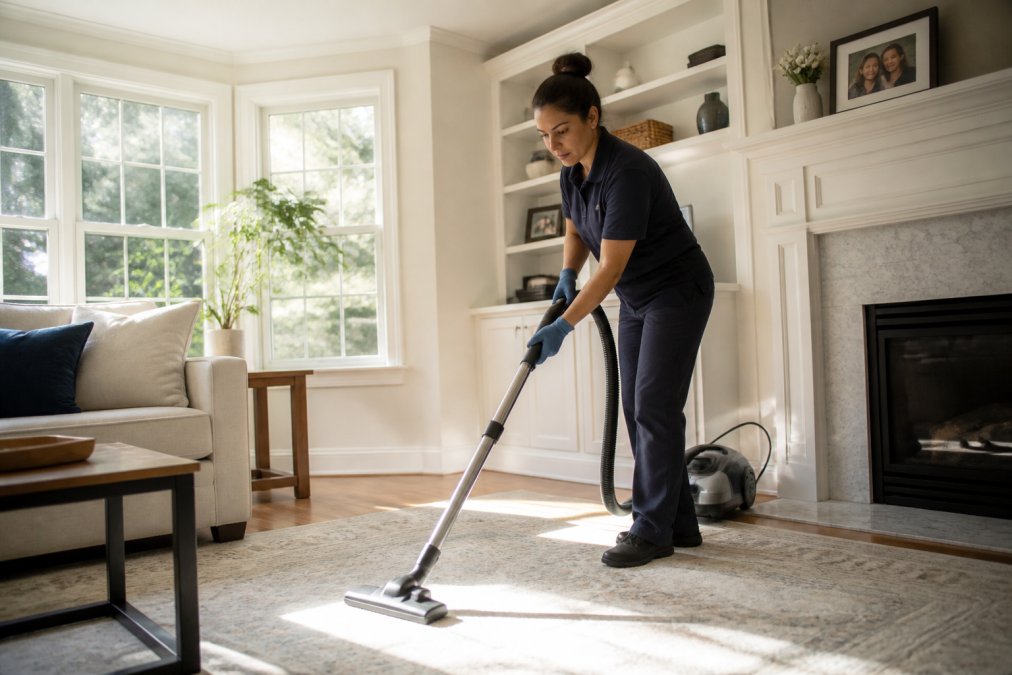
What Professional Crews Do Differently
Professional crews rotate equipment, use microfiber systems with the right weave for each surface, and follow disinfection protocols that reduce pathogen control gaps. The practical differences that matter for air quality:
- Sealed HEPA systems on commercial vacuums, so captured particles stay captured instead of leaking at the seal.
- Dwell time discipline. Disinfectants need the label’s stated contact time to work. A quick wipe-and-go does not meet it.
- Microfiber rather than cotton. Microfiber’s split fibers trap and hold particles that cotton rags push around.
- Source removal over surface wiping. Mattress and upholstery treatment targets where dust mites actually live, not just the visible surface.
A vacuum labeled “HEPA-style” or “HEPA-type” is not the same as a sealed HEPA system. The distinction is the seal, and it is the difference between capturing fine particles and recirculating them.
The Wellness Angle Most Guides Miss
The air-quality conversation usually stops at allergens. The wellness layer is broader: fine particulate matter in the 2.5 micron range is linked to respiratory and cardiovascular effects, and indoor sources, cooking, candles, dust disturbance, contribute to that load. A cleaning method that removes rather than redistributes fine particles is doing more than reducing sneezes. It is lowering the daily particulate burden in the space where you spend most of your hours.
Eco-Friendly Cleaning Standards and Long-Term Home Preservation
The right product for the surface matters more than scrubbing harder. Mismatched chemicals cause more long-term damage than dirt does.
North Shore Maids offers green cleaning products upon request, so health-conscious households can align the service with their standards without giving up professional expertise.
Frequently Asked Questions
What is the difference between professional cleaning and regular DIY cleaning?
Professional cleaning uses commercial-grade equipment and proven methods that go beyond surface wiping. Teams follow disinfection protocols, use HEPA filtration for allergen reduction, and clean high-touch surfaces, baseboards, and inside appliances consistently. DIY cleaning typically covers visible areas with consumer products. The gap shows up in indoor air quality, microbial growth prevention, and how thoroughly germ transmission hotspots get treated. Professional cleaning also brings trained expertise and consistent standards to every visit.
How does a clean home environment contribute to mental wellness?
A maintained home reduces visual clutter and the mental load of an endless to-do list. Research on clutter and stress suggests that disorganized spaces can raise cortisol levels, while orderly environments support focus and calm. The mental health benefits of a clean home include lower daily stress, better work-life balance, and a stronger sense of control. For dual-income households, outsourcing cleaning removes a recurring source of friction and frees time for rest and family.
What are the health risks of improper DIY cleaning methods?
Mixing the wrong products, like bleach and ammonia, creates toxic fumes. Overusing disinfectants on every surface can increase chemical exposure and irritate airways, especially in children and pets. Skipping high-touch surfaces or letting moisture sit encourages microbial growth and germ transmission. Professional cleaners are trained on safe dilution ratios, dwell times, and ventilation, which reduces these risks while achieving better pathogen control and allergen reduction.
Is hiring a professional cleaning service worth the investment for stress reduction?
For many households, yes. The cost-effectiveness of professional cleaning goes beyond the hourly rate. You avoid buying specialized equipment, replacing damaged surfaces from harsh products, and spending weekends on labor-intensive deep cleaning. Recurring service keeps your home at a consistent standard, which lowers stress management demands and supports preventative maintenance. Request a free estimate to see how a flexible plan fits your budget and schedule.