
Table of Contents
- What Is Included in a Standard Move Out Clean: Room-by-Room Checklist
- How Long Does a Move Out Clean Take?
- Essential Cleaning Supplies for Move Out
- Tips for Getting Your Security Deposit Back
- Move-Out Clean vs. Regular Clean: Key Differences
- Time Management and Scheduling Your Move Out Clean
- When to Hire Professional Move Out Cleaning Services
- Frequently Asked Questions
Last Updated: September 13, 2026
What Is Included in a Standard Move Out Clean: Room-by-Room Checklist
A standard move out clean is a top-to-bottom deep cleaning of an empty rental unit, covering appliance interiors, cabinet shelves, baseboards, window tracks, and every surface a landlord inspects during a walk-through. This guide from North Shore Maids breaks down that checklist.
Most tenants lose part of their security deposit because they cleaned the way they clean every week (peer-reviewed research). A move out clean is a different job with a different standard, and knowing what a landlord inspects changes how you spend your final weekend.
Below is the room-by-room breakdown, plus timing, supplies, and when to hire a professional.
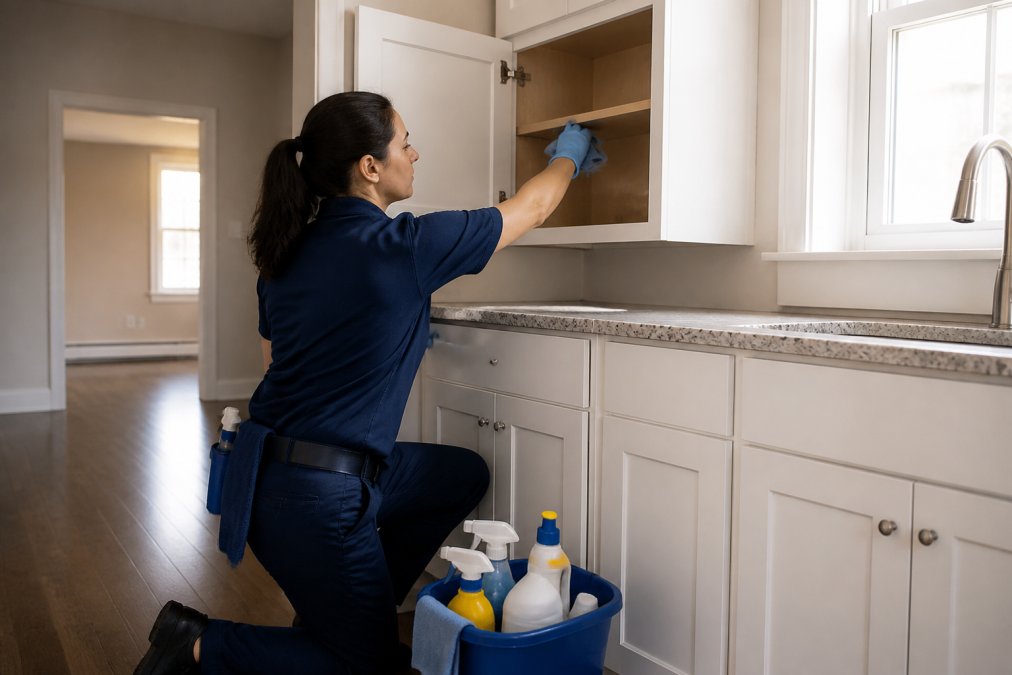
Kitchen: Appliances, Cabinets, and Grates
The kitchen takes the longest of any room and is where inspections are strictest. A standard move out clean covers the oven interior, stovetop grates and drip pans, refrigerator shelves and drawers, microwave interior, dishwasher filter, cabinet interiors, and the range hood filter.
Grease is the enemy. A degreaser left to sit for several minutes lifts baked-on residue far better than scrubbing immediately. Pull the refrigerator out, clean behind it, and vacuum the condenser coils. Wipe all appliance exteriors, including the tops of the refrigerator and upper cabinets, which collect a sticky film most tenants never notice.
Vacuum cabinet interiors before wiping; a wet cloth just smears settled crumbs.
Photograph the inside of the oven and refrigerator after cleaning. If a landlord later claims they were dirty, dated photos settle the dispute before it reaches the deposit.
Bathrooms: Scrubbing, Descaling, and Disinfecting
Bathrooms are where residue gets judged hardest. The scope includes toilet bowls, tanks, and bases; tub and shower surrounds; tile and grout; glass doors; sinks; faucets; vanity interiors; exhaust fans; and mirrors.
Descaling matters more than scrubbing. Mineral buildup on faucets and showerheads comes off with a mild acid, such as white vinegar, left to sit before wiping (extension.psu.edu). Grout cleaning requires a stiff brush and patience; a stained grout line reads as neglect even when the porcelain is spotless.
Exhaust fan covers pop off and collect dust that drops back onto the room, so clean them. Wipe the base of the toilet and the floor bolts, areas skipped in routine cleaning and inspected during a walk-through.
Living Areas and Bedrooms: Dusting, Walls, and Floors
Living spaces are about dust, not grime. The checklist covers horizontal surfaces, ceiling fan blades, light fixtures, vents, baseboards, window sills and tracks, closet shelves and rods, and the inside of all drawers.
Dust top-down: ceiling fans and light fixtures first, then shelves and sills, then baseboards, then floors. Working the other direction just moves dust onto surfaces you already cleaned. Microfiber cloths trap dust rather than spreading it, which is why they outperform paper towels.
Walls need spot cleaning, not full washing. Scuff marks, food splatter near switches, and handprints around door frames come off with a mild all-purpose cleaner and a soft cloth. Aggressive scrubbing on flat paint leaves a dull patch worse than the mark.
Vacuum carpets edge to edge, including under where furniture sat, and mop hard floors after vacuuming. Vacuum upholstery if any furniture stays behind.
Do not paint over damage or spackle holes without matching the existing finish. A landlord will spot an unmatched patch instantly, and it often converts a minor repair into a full repaint charged against the deposit.
How Long Does a Move Out Clean Take?
A move out clean typically takes four to eight hours for a one- or two-bedroom unit, and longer for larger homes or heavy buildup (cleaninginstitute.org). The range depends on square footage, condition, and how regularly the unit was cleaned during the tenancy.
Time-boxed scenarios
The 4-hour clean (maintained unit, 1 bedroom). Cleaned weekly, no pets, no smoking, appliances wiped after use. You are refreshing, not rescuing. Budget roughly: kitchen 90 minutes, bathroom 45 minutes, living areas and bedroom 60 minutes, floors 45 minutes.
The 8-hour clean (average unit, 2 bedrooms). Normal lived-in condition, some grease buildup, grout starting to discolor, carpets needing edge vacuuming. Budget roughly: kitchen 2.5 hours, bathrooms 1.5 hours, living areas and bedrooms 2 hours, floors 2 hours. A full day solo, or a half-day for two working in parallel.
The 2-day clean (neglected unit or 3+ bedrooms). Heavy grease, stained grout, pet odors, or a unit not cleaned regularly. The kitchen alone can take 3 to 4 hours once you account for degreaser dwell time and oven cycles. Split it: kitchen and bathrooms day one, everything else plus floors day two. Compressing this into one day is how deposits are lost.
Per-room time estimates
- Kitchen, 1.5 to 4 hours. The oven interior, refrigerator interior, and range hood filter are the time sinks. Degreaser needs 5 to 10 minutes of dwell time per application.
- Bathroom (each), 45 minutes to 1.5 hours. Descaling showerheads and faucets requires dwell time; grout scrubbing is the variable.
- Living areas and bedrooms, 30 to 60 minutes each, more if there are ceiling fans, many vents, or wall scuffs.
- Floors, 30 to 60 minutes per 500 square feet, more for carpet edges and hard-floor grout.
How to clean in 4 hours vs. 2 days
The difference is sequencing and dwell time, not effort. To compress a clean:
- Start every chemical working before you scrub. Apply oven cleaner, spray degreaser on the stovetop and hood, and set descaling solution on faucets and showerheads first. While those sit, clean something else.
- Work top-down in every room. Ceiling fans and light fixtures, then shelves and sills, then baseboards, then floors. Cleaning floors first means re-cleaning them after dust settles.
- Do the kitchen and bathroom first. They decide most deposit disputes. If you run out of time, you want those done, not the hallway baseboards.
- Two people beat one, but only with a division of labor. One takes kitchen and bathrooms; the other takes living areas, bedrooms, and floors. Two people in the same room usually collide.
- Do not start floors until every other surface in the unit is done. This is the single biggest time-waster in a DIY move out clean.
Scheduling around the move-out calendar
Schedule the move-out clean after all belongings are out and before the final walk-through, ideally with a full day of buffer. Cleaning around furniture means missing the floors and walls underneath it, and a rushed job on moving day is the fastest way to lose a deposit.
If the lease requires professional cleaning, book as soon as the move-out date is confirmed. Good crews fill up at month’s end, so book two to three weeks ahead for end-of-month move-outs.
If you are doing the clean yourself, block the time on your calendar the way you would a workday. A move out clean that is “squeezed in” between packing and a U-Haul rental almost always gets cut short in the kitchen and bathroom, the two rooms that matter most.
Budget more time than you think you need. Rushing the kitchen and bathroom is the most common scheduling mistake tenants make, and it is the one that shows up on the deposit statement.
Essential Cleaning Supplies for Move Out
The right supplies for a move out clean are fewer than most people expect, but they need to be correct. A basic kit covers:
- All-purpose cleaner for walls, cabinets, and surfaces
- Degreaser for the oven, stovetop, and range hood
- Descaler or white vinegar for faucets and showerheads
- Grout brush and a stiff-bristle scrub brush
- Microfiber cloths, at least six
- Squeegee for glass and mirrors
- Vacuum with a crevice attachment and a mop with a fresh head
- Trash bags and a bucket
Green cleaning products work for most of this list. Baking soda, vinegar, and plant-based degreasers handle routine soil and avoid harsh fumes in a closed-up empty unit. The exception is heavy grease and mold, where a targeted stronger product saves hours.
Buy supplies before move-out day, not during it. A mid-clean supply run costs more time than the supplies cost money.
Tips for Getting Your Security Deposit Back
Getting a security deposit back comes down to documentation, timing, and knowing what the lease requires. Most disputes are avoidable before the final walk-through, but only if you understand how a landlord evaluates the unit, not just how clean it looks to you.
Read the lease before you clean
The lease usually specifies the condition the unit must be returned in and whether professional cleaning is required. Look for three clauses: a “professional cleaning required” line, a carpet-cleaning clause, and a “normal wear and tear” definition. If the lease requires professional cleaning, your own deep clean may not satisfy it, a receipt from a licensed provider often does. If the lease is silent, you are held to a “reasonably clean” standard, a lower bar than “professionally cleaned.”
What a landlord actually inspects
A landlord’s walk-through is not a white-glove test. It is a targeted inspection of the areas that cost the most to remediate, usually in this order:
- Appliance interiors, oven, refrigerator, dishwasher, microwave. Grease and food residue are the most common deduction.
- Bathroom residue, toilet base and bolts, tub and shower surround, grout lines, and the underside of the toilet seat.
- Floors, carpet edges, under where furniture sat, and hard-floor grout or baseboards.
- Damage beyond wear and tear, nail holes, scuffs, burns, pet stains, and broken fixtures.
- Odors, smoke, pet, and cooking odors that survive cleaning often trigger a full repaint or ozone treatment charge.
Clean those five areas thoroughly and the rest of the walk-through tends to go smoothly. A spotless closet shelf rarely decides a deposit; a greasy oven almost always does.
Cleaning vs. repairs: where the line sits
This distinction is where deposits are lost. Cleaning removes soil; repairs restore or replace damaged material. You cannot clean your way out of a repair, and trying often makes it worse.
- Nail holes, small holes (roughly a pencil-width or less) are usually considered normal wear and tear. Larger holes, anchors, and wall damage are repairs. Spackling and painting an unmatched patch can convert a minor repair into a full-wall repaint charge.
- Scuffs and marks, surface scuffs that wipe off are cleaning. Scratches that cut into the finish, or paint transfer from furniture, are repairs.
- Carpet stains, fresh, water-soluble stains are cleaning. Burns, pet stains that reached the pad, and dye stains are typically replacement or professional-treatment territory.
- Grout and caulk, discoloration is cleaning. Cracked, missing, or moldy caulk is a repair.
- Broken fixtures, blinds, outlet covers, towel bars, and light fixtures are repairs, not cleaning. Replacing a broken blind is often cheaper than the deduction.
Do not paint over damage or spackle holes without matching the existing finish. A landlord will spot an unmatched patch instantly, and it often converts a minor repair into a full repaint charged against the deposit.
Documentation that actually holds up
Dated photos and video are the standard advice, but format matters. Take wide shots of each room, then close-ups of any pre-existing damage, with a timestamp visible. Photograph the inside of the oven and refrigerator after cleaning; if a landlord later claims they were dirty, dated photos settle the dispute before it reaches the deposit.
A move-in condition report signed at the start of the tenancy is the strongest evidence you can have. If you did not complete one, your move-out photos carry more weight when they show the same angles as the landlord’s inspection.
The walk-through and the clock
Request the walk-through in writing, attend if possible, and return keys on time. Most states set a deadline (commonly 14 to 30 days) for the landlord to return the deposit with an itemized statement. If you receive an unfair deduction, that statement is your starting point: it must list each charge and the reason. Respond in writing, cite the lease and your photos, and keep the tone factual. Many disputes resolve at this stage.
Spend your final weekend on the five areas landlords actually inspect, appliance interiors, bathroom residue, floors, damage, and odors, not on surfaces that were never going to be charged.
Move-Out Clean vs. Regular Clean: Key Differences
A move-out clean is a deep cleaning of an empty unit judged against inspection standards, while a regular clean maintains a lived-in home on a recurring schedule. The two jobs have different scopes and definitions of “done.”
| Aspect | Regular Clean | Move-Out Clean |
|---|---|---|
| Scope | Surface-level upkeep | Full deep clean, top to bottom |
| Appliances | Exterior wipe down | Interiors, grates, coils |
| Cabinets | Exteriors | Interiors and drawers |
| Baseboards and vents | Occasionally | Always |
| Standard | Looks tidy | Passes inspection |
| Unit condition | Furnished, occupied | Empty |
A regular clean keeps a home presentable. A move-out clean has to satisfy someone else’s checklist, a higher bar.
Time Management and Scheduling Your Move Out Clean
The practical sequence is: move everything out, clean room by room starting with the kitchen and bathrooms, then do floors last in every room. Cleaning floors first means re-cleaning them after dust settles from the walls and ceilings.
When to Hire Professional Move Out Cleaning Services
Hiring professional move out cleaning services makes sense when the unit has heavy buildup, when the lease requires it, or when the tenant’s schedule or physical capacity makes a full deep clean impractical. A move-out clean takes most people a full day or more, and the equipment and products alone add up. A professional crew arrives with the right supplies, works in parallel, and cleans to the standard a landlord expects, reducing the chance of a callback or deposit deduction.
North Shore Maids has provided home and apartment cleaning across Essex County for nearly two decades, with a bonded and insured team and green cleaning products available on request. The company offers one-time move-in and move-out deep cleans alongside flexible weekly, bi-weekly, monthly, and seasonal plans, so a single move-out clean does not require recurring service. Free estimates are available, and every job is backed by a satisfaction guarantee.
For tenants with mobility limitations or health issues, a professional clean removes the stairs, heavy lifting, and hours on hands and knees a full deep clean demands.
Frequently Asked Questions
Is a move-out clean more than a regular clean?
Yes. A move-out clean is far more detailed than a regular maintenance clean. It includes inside appliances, cabinet interiors, baseboards, window tracks, and light fixtures, which standard cleans often skip. The goal is to return the rental unit to move-in ready condition so it passes a property inspection and you recover your full security deposit.
Do professional cleaners include inside appliances in a move-out clean?
Most professional move-out cleaning services include the interior of the oven, refrigerator, and microwave as part of the standard package. Some companies charge extra for heavy degreasing or if the appliance has significant buildup. Always confirm what is included before booking so there are no surprises on your final bill.
What should I prioritize to ensure I get my security deposit back?
Focus on the areas landlords check during a walk-through: appliance interiors, bathroom grout and faucet descaling, baseboards, window tracks, and floors. These are the spots where residue removal and deep cleaning make the biggest difference. Document the condition with photos after cleaning and compare them to your move-in checklist to strengthen your case for a full deposit refund.
How long does a move out clean take?
A move-out clean typically takes two to four times longer than a regular clean. For a one-bedroom apartment, expect three to five hours. A three-bedroom home can take six to ten hours, especially if appliances need heavy degreasing or the unit has been lived in for years. Scheduling a professional team can cut the total time significantly.
A move-out clean is one of the few cleaning jobs where the result is judged by someone else, and that changes everything about how it should be approached. North Shore Maids handles move-out and move-in deep cleans across Essex County with a bonded and insured team, green cleaning products available on request, and a satisfaction guarantee on every job. Request a free estimate from North Shore Maids and leave the unit inspection-ready without spending the weekend on it.