
Table of Contents
- Start Every Clean from the Top Down
- Daily Cleaning Checklist for Busy Families
- Deep Cleaning Frequency Guide: How Often Is Often Enough?
- Disinfect High-Touch Areas and Kitchen and Bathroom Surfaces
- Flooring Maintenance: Vacuuming, Mopping, and the Right Tools
- DIY vs. Professional House Cleaning: Honest Trade-Off Analysis
- Professional House Cleaning Services in Essex County: What to Look For
- Conclusion
Last Updated: August 26, 2026
Maintaining a genuinely clean home takes more than good intentions, it takes a system. At North Shore Maids, we’ve spent nearly two decades helping Essex County families build routines that actually hold up between professional visits. The 7 best ways to maintain a clean home in Essex County come down to method, consistency, and knowing when to call in reinforcements.
Quick Picks:
- Best daily habit: A room-by-room checklist under 10 minutes per space
- Best time-saver: The top-to-bottom cleaning method, always dust before you vacuum
- Best investment for busy families: Flexible residential cleaning plans with satisfaction guarantees
| Strategy | Best For | Frequency |
|---|---|---|
| Top-to-bottom method | All households | Every clean |
| Daily checklist | Busy families | Daily |
| Deep cleaning schedule | Older New England homes | Seasonal |
| High-touch disinfecting | Households with children | 2-3x per week |
| Flooring maintenance routine | Mixed floor types | Weekly |
| DIY cleaning plan | Low-traffic homes | As needed |
| Professional cleaning service | Dual-income households | Weekly or bi-weekly |
Start Every Clean from the Top Down
The single most effective change any household can make is committing to a top-to-bottom cleaning sequence. Dust, debris, and allergens always fall downward, which means cleaning floors before wiping shelves guarantees you’ll clean them twice. Starting high and working down eliminates that redundancy entirely.
Why the Top-to-Bottom Method Saves Time
The top-to-bottom approach is a professional cleaning methodology where every task on a given surface level is completed before moving to the next lower level. Ceiling fans get wiped before counters, counters before floors. This single rule cuts cleaning time noticeably because it removes the need to re-clean surfaces that collect fallout from above. A common mistake is wiping baseboards after vacuuming, they trap dust that then falls onto the floor you just cleaned. Tackle them first, then vacuum.
Dusting Ceiling Fans, Baseboards, and High-Touch Surfaces
Ceiling fans are among the most overlooked surfaces in residential cleaning. Use a pillowcase technique: slip an old pillowcase over each blade, wipe inward, and contain the dust inside the case rather than scattering it. For baseboards, a microfiber cloth slightly dampened with water picks up fine dust without leaving moisture damage. High-touch surfaces, light switches, door handles, cabinet pulls, remote controls, need attention at least twice a week, as they transfer bacteria between household members most efficiently.
Work the room systematically: ceiling fan first, then shelves and window sills, then counters and furniture surfaces, then baseboards, and finally the floor. That sequence, applied consistently, is the backbone of efficient home hygiene.
Daily Cleaning Checklist for Busy Families
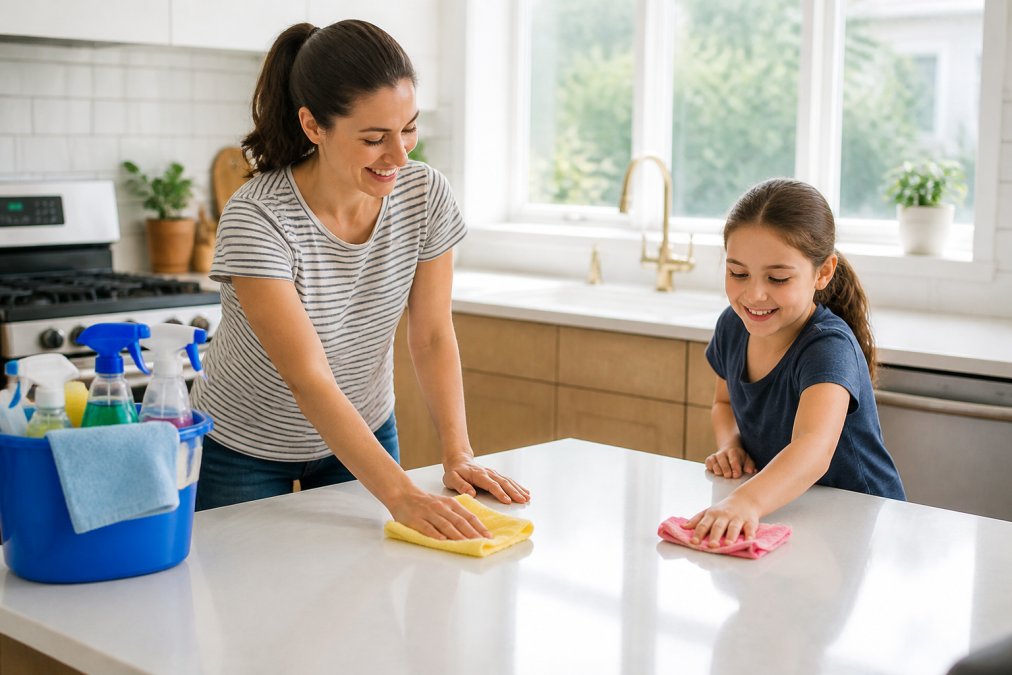
A daily cleaning checklist for busy families works best when it’s short enough to actually complete on a weekday. The goal isn’t a deep clean every day, it’s preventing accumulation. Fifteen minutes of consistent maintenance beats a three-hour weekend session every time.
Room-by-Room Quick Tasks That Take Under 10 Minutes
Assign each room a single non-negotiable task:
Kitchen (5-7 minutes)
- Wipe counters and stovetop after each meal
- Rinse and load dishes immediately
- Wipe the sink basin and faucet handles
- Sweep or spot-mop the floor near the stove and sink
Bathrooms (3-5 minutes each)
- Wipe the sink, faucet, and mirror
- Swipe the toilet seat and handle with a disinfecting wipe
- Hang wet towels to prevent mildew
Living Areas (5 minutes)
- Straighten cushions and throw blankets
- Clear flat surfaces of clutter before bed
- Do a quick floor scan for debris
Bedrooms (3 minutes)
- Make the bed, this single act makes the whole room look cleaner
- Put clothing in hampers or back in closets
Kitchens and bathrooms generate the most mess and deserve the most daily attention. Home organization and cleaning are inseparable: a cluttered surface cannot be properly cleaned, so putting things away is itself a cleaning task.
Keep a small caddy of cleaning supplies on each floor of your home. The number one reason people skip daily tasks is the friction of gathering supplies. Reduce that friction and the routine sticks.
Deep Cleaning Frequency Guide: How Often Is Often Enough?
Deep cleaning is the thorough process of cleaning surfaces, fixtures, and areas that routine maintenance doesn’t reach: inside appliances, behind furniture, inside cabinets, and along grout lines. For most households, a genuine deep clean is needed four times per year, aligned with seasonal transitions.
Seasonal Cleaning Priorities for Older New England Homes
Older homes common throughout Essex County present specific maintenance challenges. Many were built before modern insulation standards, which means drafts carry dust and moisture into living spaces more readily. According to the EPA’s guidance on indoor air quality, indoor air can be significantly more polluted than outdoor air, and older homes with less airtight construction are particularly vulnerable to dust and allergen buildup.
Seasonal priorities for New England homes:
- Spring: Focus on interior windows, window tracks, and areas around radiators or baseboard heaters that collected dust all winter.
- Summer: Deep clean kitchen appliances, including the inside of the refrigerator and oven. Humidity increases mold risk in bathrooms.
- Fall: Clean ceiling fans, replace HVAC filters, and deep clean carpets before the home closes up for winter.
- Winter: Focus on high-touch surfaces and sanitization during cold and flu season.
Deep Cleaning vs. Routine Maintenance: What Each Covers
Routine maintenance covers surfaces you see and touch daily: counters, floors, sinks, and toilets. It keeps the home presentable and hygienic at a surface level.
Deep cleaning goes further: inside the oven, under and behind appliances, inside kitchen and bathroom cabinets, along baseboards, inside the refrigerator, and behind the toilet. It also includes scrubbing grout, descaling faucets, and washing light fixtures.
Routine cleaning takes 1-2 hours for an average home. A thorough deep clean takes 4-8 hours. Most households need routine maintenance weekly and deep cleaning quarterly.
Deep cleaning and routine maintenance are not interchangeable. Skipping deep cleaning sessions allows grime, bacteria, and allergens to accumulate in areas that look clean on the surface but aren’t.
Disinfect High-Touch Areas and Kitchen and Bathroom Surfaces
Disinfecting and cleaning are two different actions. Cleaning removes visible dirt and debris. Disinfecting kills bacteria and viruses on a surface. Both steps are necessary, in that order, a disinfectant applied to a dirty surface is far less effective because organic matter neutralizes the active ingredient.
High-touch areas requiring regular disinfecting include: light switches, door knobs and handles, cabinet pulls, faucet handles, toilet flush handles, remote controls, and stair railings. For kitchens, pay particular attention to the area around the sink and appliance handles. For bathrooms, the toilet flush handle and faucet are the highest-priority targets. The CDC guidance on household disinfection recommends using EPA-registered disinfectants and following the product’s contact time, the amount of time the surface must remain wet to achieve effective disinfection.
Products like Force of Nature, which uses electrolyzed water to create an EPA-registered disinfectant from salt, water, and vinegar, offer a non-toxic option that’s safe around children and pets while still meeting EPA List N standards for killing viruses including Influenza A.
Disinfect high-touch surfaces two to three times per week during normal conditions, and daily during cold and flu season (the CDC).
Flooring Maintenance: Vacuuming, Mopping, and the Right Tools
Floor type determines everything about your maintenance approach. The biggest mistake most households make is using the same tool and technique across every surface.
Hardwood and laminate floors need dry dust removal before any wet mopping. Vacuuming or dry-sweeping first removes the abrasive grit that scratches finished surfaces. For the wet step, a lightly dampened microfiber mop is far superior to a soaking-wet traditional mop. The E-Cloth Deep Clean Mop uses precision-engineered microfiber that removes over 99% of bacteria with just water, leaving very little moisture behind, critical for protecting wood and laminate from warping.
Carpet maintenance requires a vacuum with genuine suction and filtration. The Dyson V15 Detect uses whole-machine HEPA filtration that captures 99.99% of microscopic particles, relevant for households where allergens are a concern.
Tile and grout need periodic deep scrubbing in addition to regular mopping. Use a pH-neutral cleaner formulated specifically for finished floors.
Vacuum high-traffic areas at least twice a week. Mop hard floors weekly. Deep scrub tile grout monthly or quarterly, depending on foot traffic.
Never use a steam mop on hardwood or laminate floors unless the manufacturer explicitly approves it. The heat and moisture can cause irreversible warping and finish damage.
DIY vs. Professional House Cleaning: Honest Trade-Off Analysis
When DIY Routines Are Enough
DIY cleaning works well for households with fewer than two adults working full-time, no young children or pets, and a home under 1,500 square feet. If you can commit 30-45 minutes daily to maintenance tasks and 3-4 hours monthly to deeper cleaning, a self-managed routine is entirely viable.
The real cost of DIY isn’t the supplies, it’s the time. An average home requires roughly 6-8 hours of cleaning per month for basic maintenance. For households where that time has high opportunity cost, the math shifts quickly toward professional service.
When to Call In a Professional Cleaning Service
Professional house cleaning services make the most sense when:
- Time is genuinely scarce. Dual-income families with children rarely have the bandwidth for consistent deep cleaning without sacrificing something else.
- The home needs a reset. After a renovation, move, or long period of deferred maintenance, a professional deep clean establishes a baseline that’s much easier to maintain.
- Health or mobility limits cleaning capacity. Individuals recovering from illness or surgery, or those with mobility limitations, often cannot safely perform tasks like cleaning under furniture or reaching high surfaces.
- Consistency matters more than cost. A professional service on a regular schedule produces more consistent results than sporadic intensive DIY sessions.
Professional cleaners follow systematic methods, use commercial-grade supplies, and are trained to catch areas that most homeowners overlook: the top of the refrigerator, behind the toilet, inside the microwave, and along baseboards.
Professional House Cleaning Services in Essex County: What to Look For
Choosing a professional cleaning service is a trust decision as much as a quality decision. You’re granting someone access to your home, often when you’re not there.
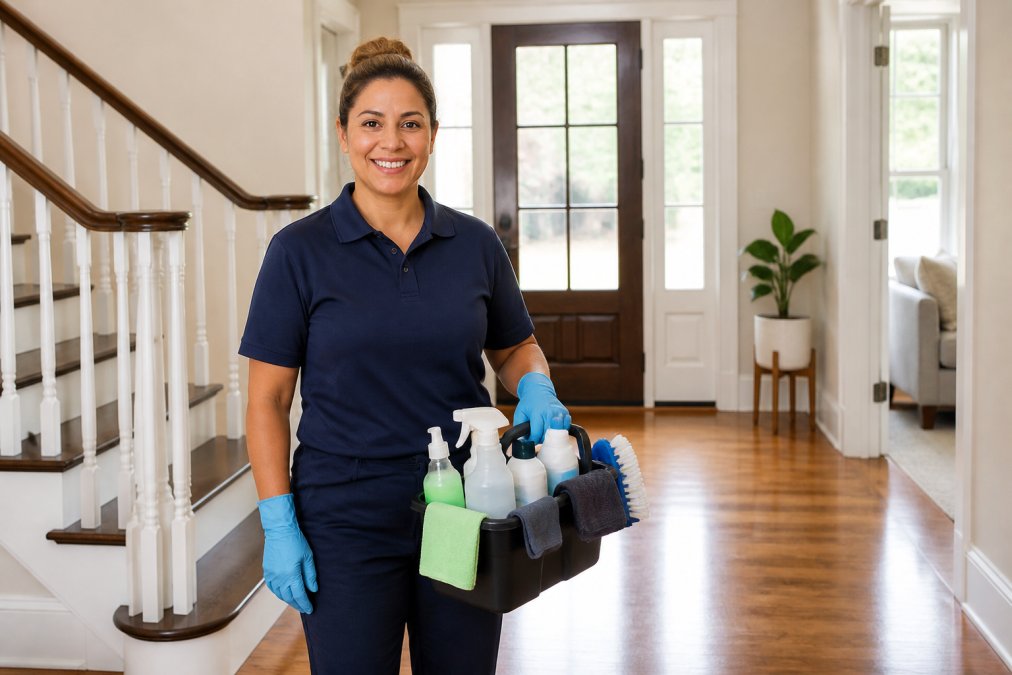
North Shore Maids provides professional house cleaning services in Essex County, backed by nearly two decades of experience serving local families and professionals. The team is bonded and insured, highly trained, and offers green cleaning products upon request. Every service comes with a satisfaction guarantee and free estimates, with plans available on weekly, bi-weekly, monthly, or seasonal schedules.
How to Vet a Local Cleaner for Security and Trust
Before booking any residential cleaning service, ask these questions directly:
- Are your employees bonded and insured? Bonding protects you if something goes missing. Insurance protects you if a cleaner is injured on your property.
- Are cleaners background-checked? A reputable service screens employees before they enter client homes.
- Do you send the same cleaner each visit? Consistency matters for both quality and security.
- What happens if I’m not satisfied? A confidence-backed service should have a clear re-clean or refund policy.
- Can I customize what gets cleaned? Standard packages often exclude tasks like inside-fridge cleaning or baseboards. Confirm what’s included or available as add-ons.
Read recent reviews that specifically mention punctuality and consistency, not just overall satisfaction.
Flexible Service Plans and Customization Options
The 7 best ways to maintain a clean home in Essex County all require some degree of customization, because no two homes or households are the same. Look for providers that offer:
- One-time deep cleans for move-in, move-out, or post-renovation situations
- Recurring maintenance plans at weekly, bi-weekly, or monthly intervals
- Customizable task lists based on your priorities
- Eco-friendly product options for households with health sensitivities
- Free estimates so you understand the scope and cost before committing
Request a free estimate and discuss your specific priorities before signing any recurring agreement.
| Cleaning Task | DIY Feasibility | Recommended Frequency | Professional Advantage |
|---|---|---|---|
| Daily surface wipe-downs | High | Daily | Low, easy to self-manage |
| Vacuuming and mopping | High | Weekly | Medium, pros cover more area faster |
| Bathroom deep scrub | Medium | Monthly | High, grout, fixtures, behind toilet |
| Kitchen appliance cleaning | Medium | Monthly | High, inside oven, fridge, hood |
| Baseboard and ceiling fan dusting | Low | Quarterly | High, often skipped in DIY |
| Full deep clean | Low | Seasonally | Very high, 4-8 hours of systematic work |
| Move-in/move-out cleaning | Very low | As needed | Essential, requires thorough baseline clean |
=== FAQ ANSWERS (audit these too, same rules) ===
[1] Q: How often should I schedule professional cleaning services?
A: For most busy households, a bi-weekly schedule keeps the home consistently clean without the cost of weekly visits. Families with young children, pets, or high foot traffic often benefit from weekly service. Monthly visits work well as a supplement to strong daily habits. If you’re unsure, a professional cleaning company can assess your home and recommend a frequency that fits both your lifestyle and your budget.
[2] Q: What are the best daily habits for maintaining a clean home?
A: The highest-impact daily habits are wiping kitchen counters after each meal, doing one load of laundry start to finish, and doing a five-minute bathroom wipe-down before bed. Putting items back where they belong immediately, rather than setting them down temporarily, prevents clutter from accumulating. These small habits reduce the time needed for weekly cleaning sessions significantly and keep your home in a presentable state throughout the week.
[3] Q: Are there specific cleaning challenges for homes in this region?
A: Older homes in Essex County often have more surface area in trim, baseboards, and built-ins that collect dust faster than newer construction. The humid coastal climate can encourage mold growth in bathrooms and basements, making regular disinfecting and ventilation critical. Salt air near the coast can also leave a film on interior windows. Adjusting your maintenance schedule seasonally, more intensive in spring and fall, helps address these regional factors before they become bigger problems.
[4] Q: How do I know if a local cleaning service is trustworthy?
A: Ask directly whether the company is bonded and insured, and whether cleaners are employees or independent contractors, employees are typically background-checked and trained to a consistent standard. Request proof of insurance before the first visit. Look for companies with verifiable local experience rather than national franchise operators, as local teams tend to have stronger accountability. A satisfaction guarantee is another indicator that the company stands behind its work.
[5] Q: How can I keep my home clean while working full-time?
A: The most practical approach combines a short daily checklist, 10 to 15 minutes each evening, with a recurring professional cleaning service for deeper tasks like mopping, sanitizing bathrooms, and cleaning appliances. Using a top-to-bottom cleaning method on weekends and keeping supplies stocked and accessible cuts the time spent on each task. Scheduling a professional deep clean every one to three months handles the tasks that fall outside a reasonable daily routine.
Frequently Asked Questions
How often should I schedule professional cleaning services?
For most busy households, a bi-weekly schedule keeps the home consistently clean without the cost of weekly visits. Families with young children, pets, or high foot traffic often benefit from weekly service. Monthly visits work well as a supplement to strong daily habits. If you're unsure, a professional cleaning company can assess your home and recommend a frequency that fits both your lifestyle and your budget.
What are the best daily habits for maintaining a clean home?
The highest-impact daily habits are wiping kitchen counters after each meal, doing one load of laundry start to finish, and doing a five-minute bathroom wipe-down before bed. Putting items back where they belong immediately, rather than setting them down temporarily, prevents clutter from accumulating. These small habits reduce the time needed for weekly cleaning sessions significantly and keep your home in a presentable state throughout the week.
Are there specific cleaning challenges for homes in this region?
Older homes in Essex County often have more surface area in trim, baseboards, and built-ins that collect dust faster than newer construction. The humid coastal climate can encourage mold growth in bathrooms and basements, making regular disinfecting and ventilation critical. Salt air near the coast can also leave a film on interior windows. Adjusting your maintenance schedule seasonally, more intensive in spring and fall, helps address these regional factors before they become bigger problems.
How do I know if a local cleaning service is trustworthy?
Ask directly whether the company is bonded and insured, and whether cleaners are employees or independent contractors, employees are typically background-checked and trained to a consistent standard. Request proof of insurance before the first visit. Look for companies with verifiable local experience rather than national franchise operators, as local teams tend to have stronger accountability. A satisfaction guarantee is another indicator that the company stands behind its work.
How can I keep my home clean while working full-time?
The most practical approach combines a short daily checklist, 10 to 15 minutes each evening, with a recurring professional cleaning service for deeper tasks like mopping, sanitizing bathrooms, and cleaning appliances. Using a top-to-bottom cleaning method on weekends and keeping supplies stocked and accessible cuts the time spent on each task. Scheduling a professional deep clean every one to three months handles the tasks that fall outside a reasonable daily routine.
Maintaining a consistently clean home is one of the most common challenges for busy Essex County households, and one of the most solvable. North Shore Maids combines nearly two decades of local experience, bonded and insured professionals, and flexible scheduling to make that consistency achievable without sacrificing your personal time. Request a free quote and choose the plan that fits your home, your schedule, and your standards.
This article was written using GrandRanker