
Last Updated: October 22, 2026
Quick Summary
Professional house cleaners are trained, insured workers who clean residential homes on a scheduled or one-time basis, handling kitchens, bathrooms, floors, and surfaces so occupants don’t have to. For busy families, the main benefit is buying back evenings and weekends that would otherwise go to household chores, along with less stress and more consistent results.
- Most busy families choose bi-weekly service, with weekly plans for larger households or homes with pets and young children.
- A standard clean covers kitchens, bathrooms, floors, dusting, and surface wiping, while deep cleans add baseboards, vents, and appliances.
- Between visits, families still handle daily messes like dishes, spills, pet accidents, trash, and general tidying.
- Ask whether cleaners are bonded and insured, whether they are employees or subcontractors, and what the satisfaction guarantee covers.
- Prep takes minutes: clear floor clutter, secure valuables and pets, and leave a note with any special requests.
Table of Contents
- Why Busy Families Are Turning to Professional House Cleaners
- The Real Benefits of Hiring Professional House Cleaners for Busy Families
- Is Hiring a House Cleaner Worth It? A Practical Cost-Versus-Time Look
- How Often to Hire a House Cleaner for Your Family’s Schedule
- What to Expect From a House Cleaning Service
- How to Prepare for a House Cleaner (Without Losing a Whole Evening)
- Choosing a Service You Can Trust: Safety, Vetting, and Communication
- Conclusion
- Frequently Asked Questions
Why Busy Families Are Turning to Professional House Cleaners
The math is blunt. A dual-income household trades roughly forty hours a week for wages, then comes home to a second shift of dishes, floors, and laundry.
Professional house cleaners exist to absorb that second shift.
Professional house cleaners are trained, insured workers who clean residential homes on a scheduled or one-time basis, handling kitchens, bathrooms, floors, and surfaces so occupants don’t have to. The category covers recurring maintenance, seasonal deep cleaning, and move-in or move-out jobs.
The value case rests on a simple trade. Families buy back evenings and weekends that would otherwise go to household chores. Below, we walk through the real benefits, the honest cost math, and the questions most guides skip.
The Real Benefits of Hiring Professional House Cleaners for Busy Families
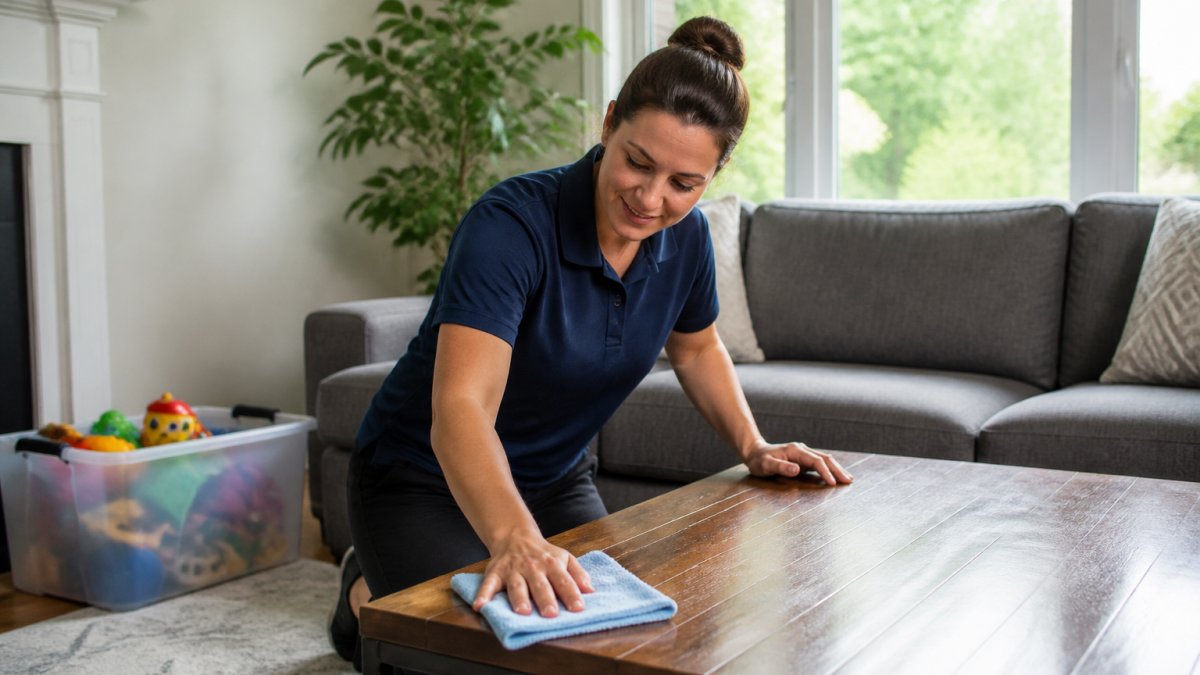
Most families come for the clean house and stay for something else: the disappearance of a low-grade guilt that followed them through every Saturday. Here are the benefits that actually show up.
Reclaimed Time for Work, Family, and the Things You Love
The clearest benefit is time. A recurring cleaning plan removes a block of household chores from the week entirely. Those hours go back to work deadlines, kids’ activities, hobbies, or simply resting.
Many families find that the weekend stops feeling like a maintenance shift. That shift is the real cost of a dirty house, and it compounds.
Less Stress, Less Weekend Guilt
Guests drop by unannounced. The in-laws announce a visit. Without a cleaning routine, every one of those moments arrives with a spike of stress.
A maintained home removes the scramble. The stress reduction is not abstract, and it is especially sharp for busy parents who already carry a full mental load.
A Healthier Home: Dust, Allergens, and Indoor Air Quality
Dust, allergens, and bacteria accumulate in exactly the places families touch most: kitchen counters, bathroom fixtures, floors, and soft furnishings. Regular professional cleaning keeps those levels down.
For households with children or pets, that consistency matters more than an occasional frantic scrub. A healthier living environment is a byproduct of a schedule, not a one-off deep clean.
Consistent, Professional-Quality Results
DIY cleaning is uneven. The bathroom gets attention; the baseboards wait a year. A house cleaning service applies the same standard every visit.
Consistent results mean the house never drifts back to square one. That predictability is what families are really paying for.
Is Hiring a House Cleaner Worth It? A Practical Cost-Versus-Time Look
Whether a house cleaner is worth it depends on what an hour of your time is worth and how many hours cleaning consumes each week. Run the comparison honestly and the answer usually becomes obvious.
Start with a simple ledger. Add up the hours your household spends on cleaning tasks weekly, then multiply by what that time could earn or what it would cost to replace.
| Factor | DIY Cleaning | Professional Service |
|---|---|---|
| Weekly hours spent | 4-8 hours | Near zero |
| Equipment and supplies | Out of pocket | Included |
| Consistency | Varies by week | Fixed standard |
| Weekend impact | Eats free time | Preserved |
| Result quality | Uneven | Professional quality |
How to Value the Hours You Reclaim
Most families underestimate what cleaning actually costs them because they count only the visible hours. A more honest ledger includes the time spent buying supplies, the time spent thinking about the mess, and the weekend hours that disappear into a maintenance shift.
A practical way to value reclaimed time is to ask three questions:
- What would you pay to have a free Saturday back?
- What is an hour of your work time worth, after taxes?
- What would it cost to replace that hour with another service you already pay for?
When families run those numbers, the comparison is rarely about whether cleaning is expensive. It is about whether the reclaimed hours are worth more than the quoted rate.
What Drives the Price of a Cleaning Service
Pricing is not arbitrary. Most providers build a quote from a small set of factors, and understanding them helps families compare apples to apples:
- Home size and number of bathrooms. More square footage and more fixtures mean more labor.
- Frequency. Recurring weekly or bi-weekly plans usually cost less per visit than one-time deep cleans because the home stays in maintenance condition.
- Condition at first visit. A home that has not been professionally cleaned in years takes longer to bring to standard.
Because these factors vary, a quote is more useful than a posted rate. Ask for a free estimate and compare it against the hours you would reclaim. A cost-effective plan is one where the reclaimed time clearly outweighs the spend, not simply the lowest quoted price.
Ask for a free estimate and compare it against the hours you would reclaim. Most families discover the break-even point arrives faster than expected once supplies and weekend time are counted.
A Simple Break-Even Exercise
Before booking, try a one-month test. Track the hours your household spends cleaning for four weeks, including supply runs and the time spent planning around mess.
If the reclaimed hours are worth more than the service cost, the decision is straightforward. If not, a less frequent plan, such as monthly maintenance with family spot-cleaning between visits, may be the better fit.
How Often to Hire a House Cleaner for Your Family’s Schedule
Most busy families land on bi-weekly service, with weekly plans for larger households or homes with pets and young children.
Frequency should match how fast your home accumulates mess, not an abstract ideal. A family of five with two dogs will outpace a couple in a small apartment.
- Weekly: Larger homes, pets, young children, heavy traffic
- Bi-weekly: The most common middle ground for busy families
- Monthly: Lighter use, singles, or supplemental maintenance
A move-in or move-out cleaning is usually a one-time deep clean, separate from any recurring schedule. Flexible plans let families adjust as circumstances change.
What to Expect From a House Cleaning Service
A standard visit covers kitchens, bathrooms, floors, dusting, and surface wiping. What counts as standard versus extra varies by provider, so confirm the scope before booking. The clearest way to set expectations is to separate three levels of service: standard maintenance, deep cleaning, and add-ons.
Standard, Deep, and Add-On Service
A standard clean is a maintenance visit. It keeps a home that is already in reasonable condition from drifting backward. Typical inclusions:
- Countertops, sinks, and appliance exteriors
- Bathroom fixtures, toilets, tubs, and mirrors
- Vacuuming, mopping, and floor care
A deep clean is a reset. It is usually a one-time service for a first visit, a seasonal refresh, a move-in or move-out, or a home that has gone a long time without professional attention.
Add-ons are individual tasks priced separately, often available with either a standard or deep clean. Common examples include inside the fridge, inside cabinets, interior windows, laundry, and organizing projects.
What Families Still Handle Between Visits
Professional cleaning is not continuous cleaning. Between visits, families still handle daily messes: dishes, spills, pet accidents, trash, and general tidying. A good service reduces the backlog, but it does not eliminate the small daily tasks that come with living in a home.
That distinction matters for expectations. A bi-weekly plan works best when the household does light daily upkeep and lets the service handle the deeper recurring work.
Questions That Clarify Scope Before You Book
A short list of questions prevents most first-visit surprises:
- What exactly is included in a standard visit?
- Which tasks are considered deep cleaning or add-ons?
- Do you bring supplies and equipment, or should we provide them?
Assuming a standard clean includes inside appliances or baseboards leads to disappointment on the first visit. Confirm the scope in writing before the crew arrives.
Getting the scope in writing is the single most useful step a family can take. It turns a vague promise into a checklist both sides can point to, and it makes the first visit a fair test of the service rather than a guessing game.
How to Prepare for a House Cleaner (Without Losing a Whole Evening)
Preparation takes minutes, not hours. Clear clutter from floors and surfaces, secure valuables and pets, and note any priorities you want addressed.
A short checklist keeps it painless:
- Pick up toys, clothes, and floor clutter
- Put away personal documents and valuables
- Secure pets in a comfortable space
That is the whole list. The point of hiring help is to stop doing the work yourself, so don’t turn prep into a second job.
Choosing a Service You Can Trust: Safety, Vetting, and Communication
Trust is the deciding factor for most families, and it should be. Ask directly whether the company is bonded and insured, how it vets and trains employees, and what happens if something goes wrong.
A few questions separate serious providers from the rest:
- Are your cleaners bonded and insured?
- Are they employees or subcontractors?
- What is your satisfaction guarantee?
Clear communication matters as much as credentials. A provider that answers these plainly, offers a free estimate, and puts the scope in writing is signaling how it will behave after you sign.
North Shore Maids has built its service around exactly these concerns: bonded and insured staff, nearly two decades of experience, satisfaction guaranteed, and green cleaning products available on request. Families comparing local providers should weigh that track record.
Conclusion
The real challenge for busy families isn’t finding a cleaner. It’s deciding whether the hours lost to household chores are worth more than the cost of reclaiming them.
North Shore Maids answers that question with flexible weekly, bi-weekly, monthly, and seasonal plans, bonded and insured cleaners, and a satisfaction guarantee backed by nearly two decades of local experience. Request a free estimate and see what your weekends are actually worth.
Frequently Asked Questions
Is hiring a house cleaner worth it for a busy family?
For most dual-income families, yes. The trade is straightforward: you exchange money for reclaimed hours that would otherwise go to cleaning tasks, and you get consistent professional-quality results instead of rushed weekend scrubbing. The value depends on how much your free time is worth to you and how much stress the cleaning routine causes. Families with young children, demanding work schedules, or health concerns often see the strongest return. Request a free estimate to compare the cost against the hours you would reclaim each month.
How often should a busy family schedule house cleaning?
Weekly and bi-weekly plans suit most busy families because they keep dust and clutter from building up and reduce the need for heavy deep cleaning later. Monthly service works for smaller households or apartments with light traffic, while seasonal deep cleans fit families who handle routine tidying themselves. Consider pets, children, allergies, and how much time you realistically have for chores. A flexible provider can adjust frequency as your schedule changes.
What should families expect from a professional house cleaning service?
Expect a walkthrough or quote, a clear scope of what is included (typically kitchens, bathrooms, floors, dusting, and surface cleaning), and a consistent team or vetted employees. Reputable services are bonded and insured, arrive within a scheduled window, and offer satisfaction guarantees. Ask ahead about extras like inside the fridge, baseboards, or inside cabinets, since these may be add-ons. Confirm whether green cleaning products are available if children or pets are in the home.
How can families prepare their home for a cleaner?
Keep it simple. Pick up clutter and personal items from floors and counters, secure pets, and clear valuables or sensitive documents. Leave instructions for anything specific, like a preferred product or a room to skip. You do not need to clean before the cleaner arrives; tidying is enough. Confirm access details, such as a spare key or door code, and note any parking or building entry instructions so the team can start on time.