
Last Updated: October 24, 2026
Quick Summary
Small business cleaning services cost in Massachusetts is driven by square footage, cleaning frequency, task scope, and local labor rates, with typical per-square-foot bands of $0.08-$0.14 for low-density open-plan offices and $0.18-$0.30 for medical or dental offices per visit. A 1,200-square-foot professional suite at $0.15 per square foot runs about $180 per visit, or roughly $720-$780 per month for weekly service.
- Per-square-foot pricing shifts with room density, not just floor area, so identical sizes can price differently.
- Recurring weekly or biweekly service spreads travel and setup costs, so per-visit prices typically fall as frequency rises.
- Hourly rates suit one-time or variable-scope jobs; per-visit flat rates suit recurring service with stable scope.
- Before signing, confirm the quote states square footage, visit frequency, full task list, and exclusions in writing.
- Ask for a certificate of insurance showing current general liability and workers’ compensation coverage before signing any contract.
Table of Contents
- How Small Business Cleaning Services Are Priced in Massachusetts
- Commercial Cleaning Cost per Square Foot: What Drives the Number
- Commercial Cleaning Hourly Rates vs. Per-Visit Pricing
- How Often Should an Office Be Clewed?
- Residential vs. Small Business Cleaning Costs: A Side-by-Side Look
- The Commercial Cleaning Quote Checklist Every Small Business Needs
- Regional Price Differences Across Massachusetts
- Request a Free Estimate for Your Essex County Business
- Frequently Asked Questions
How Small Business Cleaning Services Are Priced in Massachusetts
Small business cleaning services cost in Massachusetts depends on a short list of variables: square footage, cleaning frequency, task scope, and local labor rates.
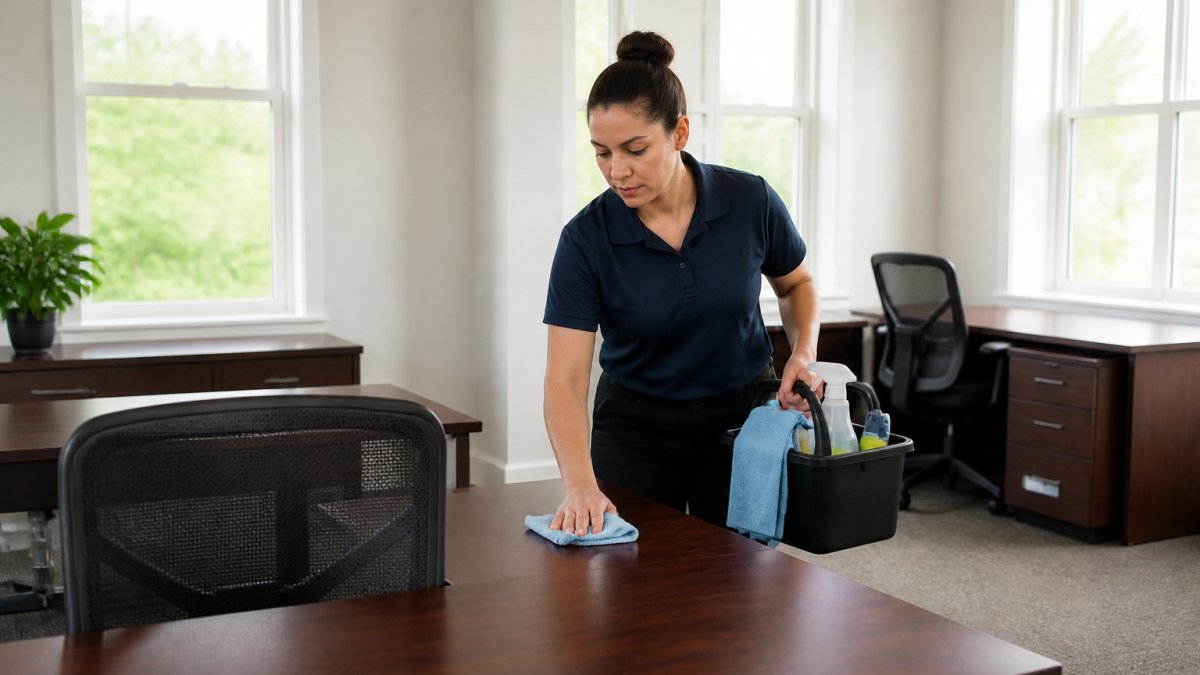
Most owners assume the number is arbitrary. It isn’t.
The practical takeaway: ask for the assumptions behind a quote. Square footage, visit frequency, and the task list explain most of the variation between two bids for the same office.
Commercial Cleaning Cost per Square Foot: What Drives the Number
Commercial cleaning cost per square foot is the most useful benchmark for comparing bids, because it normalizes quotes across different building sizes. It is not a fixed rate.
A 2,000-square-foot open office with ten desks is faster to clean than 2,000 square feet split into private offices, a kitchen, and three bathrooms. More rooms mean more edges, more fixtures, and more time. That is why two spaces of identical size can carry noticeably different per-square-foot figures.
Typical Per-Square-Foot Bands for Small Commercial Spaces
These are planning ranges, not quotes, every bid should be confirmed in writing against your actual scope.
| Space Type | Typical Per-Sq-Ft Band (per visit) | What Pushes It Up |
|---|---|---|
| Open-plan office, low density | $0.08-$0.14 | Few restrooms, minimal clutter |
| Professional suite with private offices | $0.12-$0.20 | Room count, glass, client-facing areas |
| Salon or spa | $0.15-$0.25 | Hair, product residue, wet areas |
| Retail shop | $0.10-$0.18 | Fitting rooms, glass frontage, floor traffic |
| Medical or dental office | $0.18-$0.30 | Disinfection protocols, regulated waste handling |
Worked Examples With Stated Assumptions
Transparent estimates state their assumptions so you can compare them fairly. Here is how the math works for three common small-business settings, each assuming a recurring weekly visit, supplies and equipment included, trash removal and restroom restocking in scope, and a crew of two:
- 1,200-square-foot professional suite, one restroom, one kitchenette. At $0.15 per square foot per visit, that is about $180 per visit, or roughly $720-$780 per month for weekly service. Assumes desks are cleared before the crew arrives.
- 2,500-square-foot retail shop, two fitting rooms, glass frontage. At $0.14 per square foot per visit, that is about $350 per visit, or roughly $1,400-$1,520 per month weekly. Assumes floor care is sweep-and-mop, not strip-and-wax.
- 3,000-square-foot open office, four restrooms, break room. At $0.12 per square foot per visit, that is about $360 per visit, or roughly $1,440-$1,560 per month weekly. Assumes no after-hours security escort is required.
Change any assumption, add a second weekly visit, add floor stripping, add a security-escorted night shift, and the number moves. That is the point: a per-square-foot rate without assumptions is not comparable to anything.
The Drivers That Move the Number Most
- Bathroom and kitchen count. These are the slowest rooms per square foot in any building.
- Floor type. Carpet, tile, and hardwood each need different equipment and time; periodic floor care is usually quoted separately.
- Clutter density. Desks covered in paper and personal items slow a crew down.
A common mistake is comparing per-square-foot rates without checking what tasks are included. A low rate that excludes trash removal or restroom restocking is not a lower price. It is a shorter job.
Ask every bidder for the same three numbers: square footage used, per-visit price, and the task list behind it. If two quotes disagree, the difference is almost always in the assumptions, not the rate.
Commercial Cleaning Hourly Rates vs. Per-Visit Pricing
Commercial cleaning hourly rates and per-visit pricing are two ways to quote the same work, and each one shifts risk to a different party. Hourly billing charges for time spent; per-visit pricing charges a flat amount for a defined scope. The choice changes how a quote behaves when a job runs long.
Hourly rates work best for one-time or unpredictable jobs: a post-renovation clean, a seasonal deep clean, a move-out. Per-visit pricing suits recurring service, where the scope stays stable and the owner wants a predictable monthly cost.
What a Fully Loaded Hourly Rate Includes
A fully loaded rate is the true cost of one crew hour, not just wages. It bundles payroll taxes, workers’ compensation insurance, supplies, equipment, travel between jobs, supervision, and the cleaning company’s margin. Two quotes with similar hourly figures can hide very different loaded costs.
For a deeper comparison of these two models, see flat rate vs hourly cleaning.
| Pricing Model | Best For | Risk Sits With |
|---|---|---|
| Hourly rate | One-time, deep, or variable-scope jobs | The client if scope creeps |
| Per-visit flat rate | Recurring weekly or biweekly service | The cleaning company |
How Often Should an Office Be Clewed?
How often an office should be cleaned depends on headcount, foot traffic, and whether clients visit the space. A five-person office with light traffic often runs well on weekly service.
Frequency also drives cost more than almost any other factor. Recurring service spreads travel and setup across more visits, so the per-visit price typically falls as frequency rises. One-time cleaning carries the highest per-visit cost because nothing is shared.
A sensible starting point for most small offices:
- Weekly: small teams, low traffic, no public-facing area
- Twice weekly: shared kitchens, regular client meetings
- Three or more visits: high-traffic retail, medical, or customer lobbies
Residential vs. Small Business Cleaning Costs: A Side-by-Side Look
Residential and small business cleaning costs diverge because the work itself differs. A house clean centers on kitchens, bathrooms, bedrooms, and living areas.
Home cleaning is usually priced per visit by room count and condition.
Most cost guides mix household pricing, commercial janitorial rates, and startup advice in one page. This comparison separates them, because a small-business owner needs the commercial side stated plainly.
The Same Scope, Priced Two Ways
| Dimension | Residential Clean | Small Business Clean |
|---|---|---|
| Primary pricing unit | Per visit, by room count and condition | Per square foot per visit, or flat per-visit rate |
| Typical visit length | 2-4 hours for a 3-bedroom home | 1.5-4 hours for a 1,200-3,000 sq ft suite |
| Restrooms in scope | 2-3 household bathrooms | Often 2-6 commercial restrooms, restocked |
| Trash | Household bins | Desk-side and common-area bins at commercial volume |
| Supplies | Usually included | Included or itemized; commercial dispensers may be client-supplied |
| Frequency pattern | Weekly, biweekly, monthly | Weekly to nightly, depending on traffic |
| Contract | Often none; per-visit booking | Usually a written service agreement with term and cancellation terms |
| Insurance expectation | Bonding common | General liability and workers’ comp certificates expected |
What the Numbers Look Like Side by Side
A comparable three-bedroom home on weekly residential service typically prices per visit rather than per square foot, and the visit is usually shorter because there are no commercial restrooms, break rooms, or common areas to service.
The two can land near each other in monthly spend. The difference is what the money buys: the business clean carries restroom restocking, commercial trash volume, after-hours access, insurance certificates, and a written agreement. Those are the line items a residential quote does not include.
Why the Comparison Matters When You Request Bids
A business quote should spell out restrooms, trash, and common areas explicitly. If a bidder hands you a residential-style per-visit number with no square footage and no task list, you cannot compare it to a commercial bid, and you cannot tell whether restroom restocking or floor care is included.
Massachusetts-specific residential figures are useful as a reference point; see weekly house cleaning costs in Massachusetts for that side of the comparison. The important distinction is scope, not size.
When you compare a home-cleaning quote to a business quote, put both on the same footing first: ask each bidder for square footage, visit frequency, task list, and what is excluded. Only then compare the totals.
The Commercial Cleaning Quote Checklist Every Small Business Needs
A commercial cleaning quote checklist turns a vague bid into a comparable document. Before signing, confirm the quote states square footage, visit frequency, the full task list, and what is excluded. If any of those are missing, ask for them in writing.
Use this checklist when reviewing bids:
- Square footage and room count stated
- Visit frequency and days specified
- Full task list attached, including restrooms and trash
To understand what a professional firm typically provides before you evaluate quotes, read business cleaning companies: what to expect.
Contract Terms and Insurance to Verify Before Signing
Insurance and bonding are non-negotiable checks before any contract is signed. Ask for a certificate of insurance showing general liability and workers’ compensation coverage, and confirm the policy is current.
Contract terms deserve the same scrutiny. For a step-by-step verification process, see how to verify bonded and insured cleaning services.
Watch out: signing a contract before seeing a certificate of insurance leaves the business exposed if a worker is injured on site.
Regional Price Differences Across Massachusetts
Cleaning prices vary across Massachusetts because labor costs and building density vary. Urban cores with higher rents and wages tend to carry higher rates than suburban and rural areas.
Within Essex County, quotes shift by town and by building type.
The practical move is to get local quotes and compare them on the same scope. A quote built for a specific building beats any published average.
Request a Free Estimate for Your Essex County Business
Getting an accurate number starts with a walkthrough, not a phone guess. North Shore Maids provides free estimates for small businesses across Essex County, backed by nearly two decades of local experience and a satisfaction guarantee. The team is bonded and insured, and flexible package plans cover weekly, biweekly, and monthly service.
Ready to price your space? Request a quote and get a written estimate built around your building, your schedule, and your task list.
Frequently Asked Questions
How do commercial cleaners calculate the cost of cleaning a small business?
Most cleaners build a quote from three inputs: the square footage and surface count, how often you want service, and the task list. They estimate visit duration, multiply it by a fully loaded labor rate that covers wages, payroll taxes, insurance, supplies, equipment, and overhead, then add a margin. A 1,500-square-foot office cleaned weekly prices differently than the same space cleaned monthly, even with an identical task list. Ask for the assumptions behind any cleaning services cost estimate in writing.
Is commercial cleaning charged by the hour or by square foot?
Both models exist, and some companies blend them. Hourly billing charges for time on site plus supplies, which suits one-time or unpredictable jobs. Per-square-foot pricing sets a rate tied to floor area and visit frequency, which is easier to budget for recurring office cleaning. Neither model is automatically cheaper. Compare quotes on the same scope and frequency, and ask whether travel time, restroom supplies, and periodic deep cleans are included or billed separately.
How often should a small office be cleaned?
Weekly service fits most small offices with five to fifteen staff and shared restrooms. Biweekly works for low-traffic suites, private offices, and businesses where staff tidy up daily. High-traffic spaces such as clinics, waiting rooms, and lunchrooms often need two or three visits a week. Restrooms and break areas drive the schedule more than desk space does. Start with the frequency your restroom count and foot traffic justify, then adjust after a month of service.
What should a small business check in a cleaning service agreement?
Confirm the task list, visit frequency, and arrival window in writing, plus what counts as extra (inside appliances, carpet extraction, post-construction work). Verify the company carries general liability insurance and workers’ compensation, and ask for a certificate naming your business. Check the cancellation policy, the notice period for changes, and whether the rate is locked for the contract term. A written scope and proof of insurance protect you more than a low per-visit price.
Pricing a cleaning contract comes down to scope, frequency, and verified insurance, not the lowest headline rate. North Shore Maids helps Essex County businesses get a clear, written estimate with no guesswork, backed by bonded and insured crews, flexible plans, and a satisfaction guarantee. Get started with North Shore Maids and turn a vague cleaning budget into a defined monthly cost.
