
Last Updated: November 11, 2026
Quick Summary
Vet house cleaners for pet safety by asking them to name their products, describe dilution and rinse steps, and explain how they secure supplies and handle pets. Verify insurance, bonding, and pet-owning references, then put your pet rules in writing and run one supervised trial clean before committing.
- Ask which products they bring and whether they rinse surfaces after disinfecting.
- A cleaner passes only if they ask about your pet’s species, age, and habits.
- Verify a certificate of insurance and a current surety bond in writing.
- Skip essential oils like tea tree and eucalyptus, which are toxic to cats.
- Run one supervised trial clean and spot-check after each later visit.
Table of Contents
- Why Pet Safety Belongs in Your Hiring Checklist
- Questions to Ask a House Cleaner Before You Book
- House Cleaner Insurance and Bonding: What to Verify
- How to Identify Pet-Safe Cleaning Products
- Pet-Safe Cleaning Products for Mopping Floors
- Put It in Writing: Instructions, Agreements, and a Trial Clean
- Requesting a Pet-Safe Cleaning Quote
- Frequently Asked Questions
Why Pet Safety Belongs in Your Hiring Checklist
Pet safety is the practice of protecting animals from cleaning chemicals, residue, and hazards before, during, and after a professional cleaning visit.
Most people vet a cleaner on price and availability. That is backwards.
A cleaner who uses harsh disinfectants and skips the rinse step can leave a film on floors that a pet ingests hours later.
The stakes are practical. Curious pets explore with their noses and tongues, and a wet floor invites them to lick it.
Questions to Ask a House Cleaner Before You Book
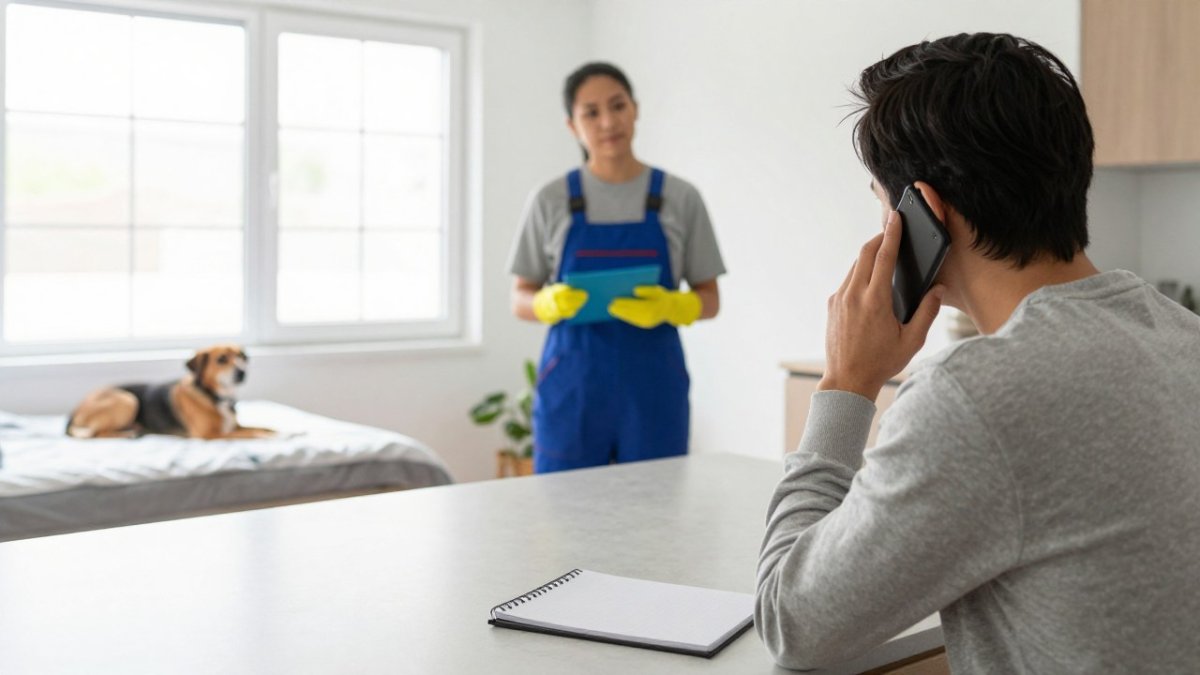
The best questions to ask a house cleaner are the ones that reveal what products they use, how they handle animals, and whether their answers hold up under follow-up. Ask them before you book, not after the first visit.
Screening Questions About Products and Methods
Start with the chemicals. A cleaner who cannot name their products is a risk.
- Which cleaning products do you bring, and can you share the labels or safety data sheets?
- Do you use bleach, ammonia, or quaternary disinfectants on floors?
- Do you rinse surfaces after disinfecting, or leave them wet?
- Can you use products I supply instead of your own?
- How do you handle dilution, and do you follow manufacturer instructions?
- What is your drying time before pets can return to a room?
A common mistake is accepting “we use green products” as a full answer. Green is a marketing word. Ask for the actual product names, then look them up.
Watch out: a cleaner who says pets “are fine” without asking about your animal’s habits has not thought about exposure. Cats groom their paws constantly. Dogs lick floors. The right answer includes questions back to you about species, age, and behavior.
Screening Questions About Handling Pets
Next, ask how the team works around animals.
- Will you keep pets away from wet floors, or should I?
- How do you secure supplies so a pet cannot reach them?
- Have you cleaned homes with cats, dogs, or both?
- What do you do if a pet gets into a cleaned room before it dries?
- How do you handle open doors and gates during a visit?
Evaluate the answers against your own home. A cleaner who has worked with cats will know that cats jump on counters and investigate wet surfaces. A dog-savvy cleaner will ask whether your dog chews, bolts for the door, or resource-guards toys. If the answer is generic, ask a follow-up: “What would you do if my cat walked across a just-mopped floor?” The response should include rinsing, drying, and keeping the pet away, not just reassurance.
Credentials, References, and Background Checks
Pet safety is also accountability. Ask for proof that the company is bonded and insured, and confirm whether employees are background-checked. Request two or three references from households with pets, and call them.
A company that cannot produce a certificate of insurance or pet-owning references is a risk you do not need to take. For a deeper walkthrough, see hiring bonded and insured house cleaners and how to verify bonded and insured cleaning services.
How to Score the Answers
Use a simple pass/fail screen. A cleaner passes if they can name products, describe dilution and rinse steps, ask about your pet’s habits, and provide insurance and references. A cleaner fails if they deflect product questions, promise “pet-safe” without specifics, or cannot explain how they secure supplies. Two or three strong answers are not enough if one critical answer is weak; the weakest answer predicts the riskiest visit.
House Cleaner Insurance and Bonding: What to Verify
House cleaner insurance and bonding means the company carries liability coverage for damage and a surety bond that protects you against theft. Verify both in writing before the first visit. Ask for a certificate of insurance and confirm the policy is current.
Here is what to check:
- Certificate of insurance naming general liability coverage
- A current surety bond
- Coverage limits that match your home’s value
- Confirmation that employees, not just subcontractors, are covered
This matters for pet households in a specific way. If a cleaner leaves a gate open and a pet escapes, or a product harms an animal, you want a company with real coverage behind it, not a solo operator with no paper trail.
How to Identify Pet-Safe Cleaning Products
A pet-safe cleaning product is one whose label directions can be followed without leaving residue that harms animals through skin contact, inhalation, or ingestion. Identifying one means reading the label, not the front of the bottle.
Reading Labels and Manufacturer Instructions
Turn the bottle around. Look for signal words like “Caution,” “Warning,” or “Danger.” A “Danger” label signals a highly toxic product that needs careful handling and ventilation.
Key label checks:
- Active ingredients: note bleach, ammonia, and quaternary ammonium compounds
- Dilution: follow the exact ratio; stronger is not safer
- Contact time: some disinfectants need surfaces to stay wet for a set time
- Rinse instructions: if the label says rinse, rinse
- Pet warnings: many labels list animals explicitly
What most guides miss is the rinse step. A disinfectant that kills germs on a counter also sits on that counter until something licks it.
The EPA’s guidance on reading pesticide and disinfectant labels explains how signal words and directions work. For animal-specific concerns, the ASPCA Animal Poison Control Center tracks common household poison risks.
Pet-Safe Cleaning Products for Mopping Floors
Pet-safe cleaning products for mopping are typically simple: diluted white vinegar, baking soda paste for stuck spots, and mild dish soap in warm water.
A simple floor routine:
- Sweep or vacuum up debris.
- Mix a diluted vinegar solution per label guidance.
- Mop, then rinse with clean water.
- Keep pets off until the floor is fully dry.
Watch out: essential oils like tea tree and eucalyptus are toxic to cats and can harm dogs. Skip them in floor cleaners.
If you are weighing store-bought options, this review of whether non-toxic home cleaning is worth it helps. Understanding the hidden risks of traditional cleaning products also clarifies why the label matters more than the marketing.
Put It in Writing: Instructions, Agreements, and a Trial Clean
Written instructions turn a good intention into a reliable routine. Put your pet rules in the service agreement so every visit follows the same standard. Then run one supervised trial clean before you commit to a schedule. This is the step most pet owners skip, and it is the one that catches problems before they become habits.
What to Put in the Written Instructions
Your written instructions should cover:
- Which products are allowed and which are banned, by product name
- Rooms where pets stay during cleaning, and who secures them
- Required drying time before pets return to a room
- Where supplies are stored, locked and out of reach
- Who handles pets during the visit, and what to do if a pet escapes
- The spill-response procedure, including who to call
Keep the instructions to one page and post a copy where the team can see it. A common pattern is to list banned ingredients (bleach, ammonia, quaternary disinfectants, essential oils) and approved products with dilution ratios. If you supply your own products, label them clearly and store them separately from the cleaner’s supplies.
The Service Agreement
The agreement should reference your pet instructions and state that the company will follow them. Ask for a clause that requires the team to report any spill, residue, or pet exposure after each visit. If the company will not put pet-safety procedures in writing, treat that as a warning sign.
Running a Supervised Trial Clean
A trial clean lets you watch the process before you commit. Schedule it for a day when you can be home, and keep your pets in a separate room with a closed door. During the visit, watch for these checkpoints:
- Does the team confirm the product list before starting?
- Do they rinse surfaces after disinfecting?
- Do they keep supplies closed and out of reach?
- Do they secure gates and doors when moving between rooms?
- Do they tell you when a floor is wet and when it is dry?
After the visit, inspect the floors and counters. Sniff for strong chemical odors, look for wet spots, and check that supplies are stored as agreed. Ask for a quick report: what products were used, which rooms were cleaned, and whether any pet came into contact with a wet surface.
Ongoing Quality Checks
A trial clean is a snapshot, not a guarantee. Spot-check after each visit. Look for residue on floors, confirm the rinse step happened, and ask whether anything changed. If a new team member arrives, repeat the product and pet-handling questions. Rotate your checks so the team knows pet safety is a standing requirement, not a one-time conversation.
| Step | What to Do | Why It Matters |
|---|---|---|
| Screen | Ask product and pet questions | Reveals chemical risk |
| Verify | Check insurance, bonding, and references | Protects you and your pet |
| Document | Write pet rules into the agreement | Sets a repeatable standard |
| Trial | Run one supervised clean | Confirms real-world behavior |
| Monitor | Spot-check after each visit | Catches problems early |
Requesting a Pet-Safe Cleaning Quote
A good quote request gives the company enough detail to price the job and plan for your animals. Share your pet types, floor surfaces, and any rooms that need special handling.
North Shore Maids brings nearly two decades of experience, bonded and insured teams, and green cleaning products available on request. The team builds flexible weekly, bi-weekly, monthly, or seasonal plans and offers free estimates, so you can match the service to your home and your pets. Satisfaction is guaranteed.
Before you call, get pricing context so you can budget with confidence: see the average cost to clean a house.
Vetting a cleaner for pet safety takes one extra conversation and one trial visit. That small effort protects the animals that share your home.
Frequently Asked Questions
What should I ask a house cleaner about pet-safe cleaning products?
Ask which products they use by name, whether they follow label dilution and ventilation instructions, and whether they offer fragrance-free or green options. Request the safety data sheet or product label for anything applied to floors or low surfaces. Confirm they will rinse surfaces your pets lick and let floors dry fully before your pets return. A cleaner who can answer these questions specifically, rather than vaguely promising ‘safe’ products, is the one to hire.
Should I ask a house cleaning company for proof of insurance and bonding?
Yes, and ask before the first visit. Request a certificate of insurance showing general liability coverage and confirm the bonding policy in writing. Verify that the people arriving at your door are employees or vetted contractors, not unvetted subcontractors. This protects you if something is damaged or if a pet slips out during a visit. A reputable company will send documentation without hesitation.
How long should pets stay away from freshly cleaned floors?
Keep pets off cleaned floors until they are completely dry, which usually takes 30 to 60 minutes depending on ventilation and humidity. Wet floors mean paws pick up residue that gets licked off later. Follow the manufacturer’s stated drying time on the product label. Close doors, use baby gates, or take dogs for a walk during the cleaning window, and ventilate with open windows or fans to speed drying.
What cleaning products should be avoided around cats and dogs?
Be cautious with bleach, concentrated disinfectants, essential oils (especially tea tree, eucalyptus, and citrus oils, which are risky for cats), and any product labeled with strong warning statements. Never mix products, and never leave buckets or spray bottles within reach. If you suspect exposure, call your veterinarian or a pet poison control service right away. Safer choices include diluted vinegar, baking soda, and castile-soap solutions, used with proper ventilation.
