
Last Updated: November 7, 2026
Quick Summary
Local janitorial services are better for small offices because you get direct accountability, faster response times, and a cleaning plan built around a compact workspace instead of a corporate template. A locally owned provider can often quote quickly and adjust your schedule without a call center in between.
- A five-person office with a shared kitchen usually needs service two to three times per week.
- Restrooms are the most labor-intensive rooms per square foot, so a second restroom can add more to a quote than open office space.
- Ask every bidder to break out minimum monthly charges, travel fees, supply charges, and price escalation clauses in writing.
- Confirm the provider is bonded and insured and request a certificate naming your business as an additional insured.
- With a local provider, the person answering the phone is often the owner or operations lead who schedules your crew.
Table of Contents
- Why Local Janitorial Services Fit Small Offices Better
- What Office Cleaning Services Include for a Small Workplace
- Office Cleaning Frequency: How Often a Small Office Needs Service
- The Small Office Cleaning Checklist: What to Expect Each Visit
- Office Cleaning Cost: What Drives the Price for a Small Office
- How to Choose an Office Cleaning Company: A Practical Checklist
- Request a Free Quote from North Shore Maids
- Frequently Asked Questions
Why Local Janitorial Services Fit Small Offices Better
A small office rarely needs a national janitorial contract with layers of management. It needs a crew that shows up, knows the building, and answers the phone. That is the core case for why local janitorial services are better for small offices, and it comes down to accountability, response time, and a cleaning plan built around a compact workspace rather than a corporate template. North Shore Maids has provided professional cleaning across Essex County for nearly two decades. Locally owned providers in general can often quote quickly and adjust a cleaning schedule without a call center in between.
What Office Cleaning Services Include for a Small Workplace
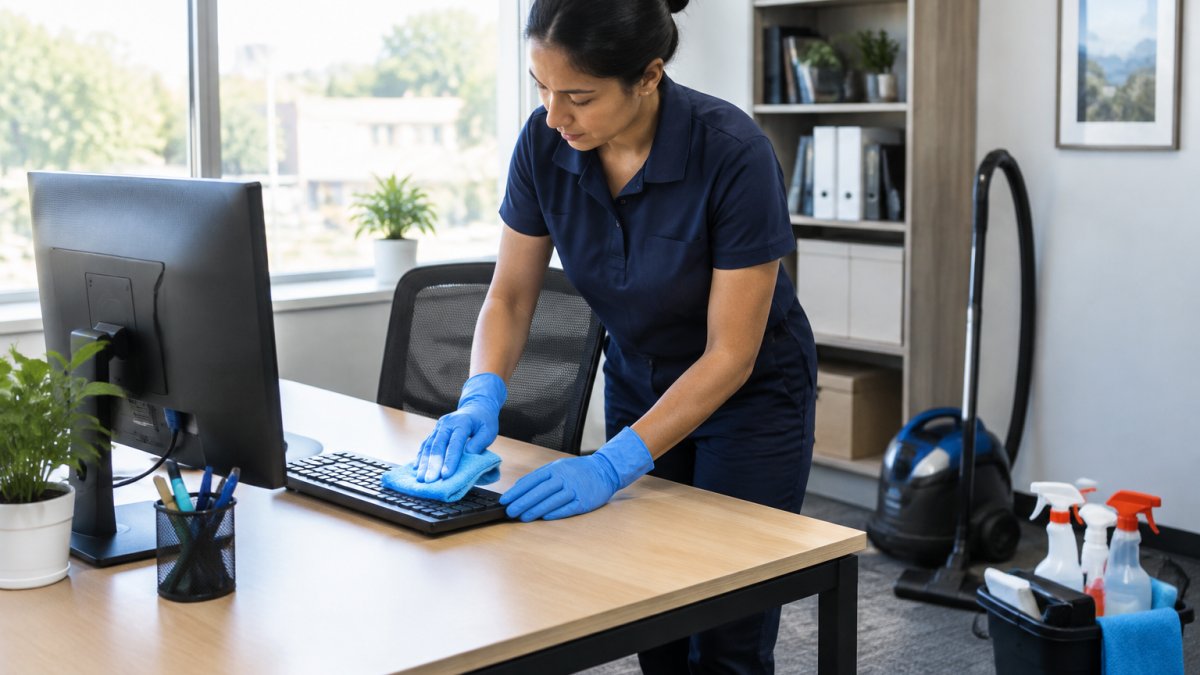
Standard office cleaning covers the shared spaces where germs and clutter collect fastest: restrooms, kitchens, and high-touch surfaces. A typical small office visit includes dusting, vacuuming, floor care, waste removal, and disinfection of door handles, light switches, and shared keyboards.
What most guides miss is the difference between a cleaning company and a janitorial provider. For a fuller breakdown of what business cleaning companies provide, see what business cleaning companies offer.
Office Cleaning Frequency: How Often a Small Office Needs Service
Office cleaning frequency depends on headcount and foot traffic, not square footage alone. A five-person office with a shared kitchen usually needs service two to three times per week. A larger workplace with daily visitors often needs nightly after-hours cleaning.
| Office Size | Typical Frequency | Best For |
|---|---|---|
| 1-5 staff, low traffic | 1-2 visits per week | Small professional suites |
| 6-15 staff, shared kitchen | 2-3 visits per week | Growing small offices |
| 15+ staff, client-facing | Nightly after-hours cleaning | High-traffic workplaces |
The mistake is locking into a rigid contract before you know your real traffic pattern. Flexible service matters here. A local provider can add a midweek visit during busy season and scale back when things slow. National franchises often route changes through a call center, which slows response time. Start with the lightest schedule that keeps restrooms and kitchens sanitary, then adjust after a month of feedback from staff.
The Small Office Cleaning Checklist: What to Expect Each Visit
A small office cleaning checklist keeps expectations concrete and makes it easy to verify quality. The best providers hand you the list before the first visit, then use it as an inspection checklist.
- Restrooms sanitized, fixtures disinfected, supplies restocked
- Kitchen counters, sink, and appliance exteriors wiped
- High-touch surfaces disinfected: handles, switches, shared keyboards
- Desks and common surfaces dusted
- Floors vacuumed and hard floors mopped
- Waste and recycling removed
- Entry glass and shared doors spot-cleaned
- Breakroom tables and chairs wiped
A common mistake is skipping the walkthrough after the first month. Ask for a short inspection checklist sign-off so you can flag missed items while they are fresh. Trained professional cleaners follow a sequence and work around occupied desks. A healthy workplace depends on consistency, not one deep clean.
Office Cleaning Cost: What Drives the Price for a Small Office
Office cleaning cost for a small office is driven by frequency, square footage, restroom count, and how much of the work happens after hours. Extras like inside-cabinet cleaning or floor care add labor, which adds cost. Most guides stop there.
Start with the four cost drivers and how each one moves the price:
- Frequency. Each additional weekly visit multiplies labor, so going from two visits to three is a roughly proportional jump, not a small add-on. Match frequency to actual restroom and kitchen traffic before you commit.
- Square footage and layout. Open floor plans clean faster per square foot than a warren of small offices, because there is less edge work, less furniture to move around, and fewer separate rooms to enter and exit.
- Restroom count. Restrooms are the most labor-intensive rooms per square foot. A second restroom can add more to a quote than several hundred square feet of open office.
- After-hours work. Nightly cleaning after staff leave often carries a premium over daytime cleaning, because labor is scheduled outside standard hours and the crew works without occupants present.
Then compare the lines that separate a low headline rate from a low real cost. Ask every bidder to break out the following, in writing:
- Minimum contract size or minimum monthly charge. Many providers set a floor below which a small office is not worth the trip. A provider with a lower floor can serve a two-room suite that a larger company would decline or price up.
- Travel or trip charges. A provider based across the region may add a travel fee or a fuel surcharge that a nearby provider does not need. Ask whether the quoted rate already includes travel.
- Supply and consumable charges. Restroom paper, soap, and liners are sometimes included and sometimes billed as a pass-through. Confirm which, and whether the price changes when supply costs move.
- Add-on charges. Inside the refrigerator, interior glass, baseboards, floor stripping and waxing, and post-construction cleanup are usually priced separately. Get the add-on menu up front so a quarterly deep clean does not arrive as a surprise invoice.
- Contract term and cancellation terms. A twelve-month term with a long notice period locks in a rate you may outgrow. A month-to-month or short-term agreement with a defined notice window costs more per visit but less in flexibility risk.
- Price escalation clauses. Ask how and how often the rate can rise, and whether increases require notice. A modest rate with an uncapped annual increase can cost more over a year than a higher flat rate.
Watch out: unusually low introductory quotes often exclude restrooms, restocking, or high-touch disinfection, and the price climbs once the contract starts. The same pattern shows up when a bid omits the minimum charge and then adds it after the walkthrough.
A cost-effective plan for a small office usually means matching frequency to real traffic, keeping the scope written down, and comparing bids on the same line items rather than on the total alone. For regional detail on small business cleaning pricing, read what small business cleaning services cost.
How to Choose an Office Cleaning Company: A Practical Checklist
Choosing an office cleaning company comes down to verifying four things: insurance, vetting, references, and response time. Skip any one and you carry the risk. The checklist below covers those four, then adds the comparison most guides leave out: how a locally owned provider and a national franchise actually differ when something goes wrong.
Verify before you sign:
- Confirm the provider is bonded and insured, and ask for a certificate of insurance naming your business as an additional insured so a claim does not land on your policy.
- Ask how staff are vetted, including background checks, and whether the same crew is assigned to your office each visit.
- Request two or three local references you can call, and ask specifically about missed visits and how they were handled.
- Get the scope and inspection checklist in writing, including what is out of scope.
- Ask how quickly they respond to a missed visit, and get the answer as a stated service level rather than a promise.
- Confirm contract flexibility, cancellation terms, and how schedule changes are requested.
Then compare local against national on the mechanics that affect a small office:
- Who answers the phone. With a locally owned provider, the person who answers is often the owner or the operations lead who schedules your crew. With a national franchise, the first contact is frequently a call center that opens a ticket and routes it to a local branch or subcontractor.
- Who can change the schedule. A local provider can usually add a midweek visit or skip a holiday week with a phone call or an email to the same contact. A franchise change often has to travel through a dispatch system, which adds a day or more before the crew sees it.
- Who is accountable for a miss. With a local provider, you can often reach a decision-maker who can send a crew back quickly.
- Workforce stability. A locally owned provider that hires and trains its own staff tends to keep the same cleaners on the same route, so they learn your office and your preferences. Franchises that rely on subcontractors can rotate crews, which resets that learning curve.
- Response time to an issue. Ask each bidder for a specific commitment: how many hours until a missed area is re-cleaned, and who you call after hours. Proximity matters here, because a provider based nearby can return the same day, while a distant one may have to schedule a return trip.
- Escalation path. Get the name and direct contact for the person who handles escalations, and confirm what happens if that person is unavailable.
Watch out: a low bid from a distant provider can look cheaper until you count the return trips and the days lost waiting for a fix. Compare bids line by line, not just on total price, and weigh the cost of your own time spent chasing a resolution.
Service reliability is the whole game. Accountability is often more direct with a local provider, since you can reach a decision-maker rather than a ticket queue. For a deeper look at hiring in this region, see how to choose office cleaning services in Essex County.
Request a Free Quote from North Shore Maids
The gap between a good janitorial plan and a frustrating one usually comes down to who is accountable when something is missed. If reliability and a tailored cleaning plan matter more than a franchise script, request a free quote and walk the space with a local team that knows the area.
Small offices do not need the biggest janitorial contract. They need the one that shows up, adapts, and answers when you call. North Shore Maids offers free estimates, flexible plans, and a satisfaction guarantee backed by nearly two decades of local work. Get started with North Shore Maids and build a cleaning schedule that fits your workplace.
Frequently Asked Questions
What are the benefits of hiring local janitorial services for a small office?
Local janitorial services typically offer faster response times, consistent cleaning staff who learn your office, and flexible schedules that fit a small team. You deal directly with the owner or local manager, so issues get resolved quickly. Local providers also know the area and can adjust plans as your needs change, without the layers of a national franchise.
How often should a small office be professionally cleaned?
Most small offices with five to twenty employees do well with cleaning two to three times per week, focusing on restrooms, kitchens, and high-touch surfaces. Offices with lighter foot traffic may only need weekly service. The right office cleaning frequency depends on headcount, whether you have a kitchen or break room, and how many visitors you see. A local provider can build a schedule around your actual use.
How much does it cost to clean a small office?
Office cleaning cost depends on square footage, cleaning frequency, and the tasks included, such as floor care or restroom sanitation. Pricing is usually quoted per visit or monthly, not as a flat hourly rate. Local providers often give free estimates after a walkthrough. Ask for a written quote that lists what is covered so you can compare bids fairly.
Can a local cleaning company customize its services for a small office?
Yes. Local providers can tailor a cleaning plan to your space, whether you need daily restroom attention, weekly dusting, or periodic deep cleans. You can adjust the small office cleaning checklist to include extras like inside the refrigerator or baseboards. Because decisions are made locally, changes to frequency or scope are usually quick and simple.
